Friday, December 09, 2016

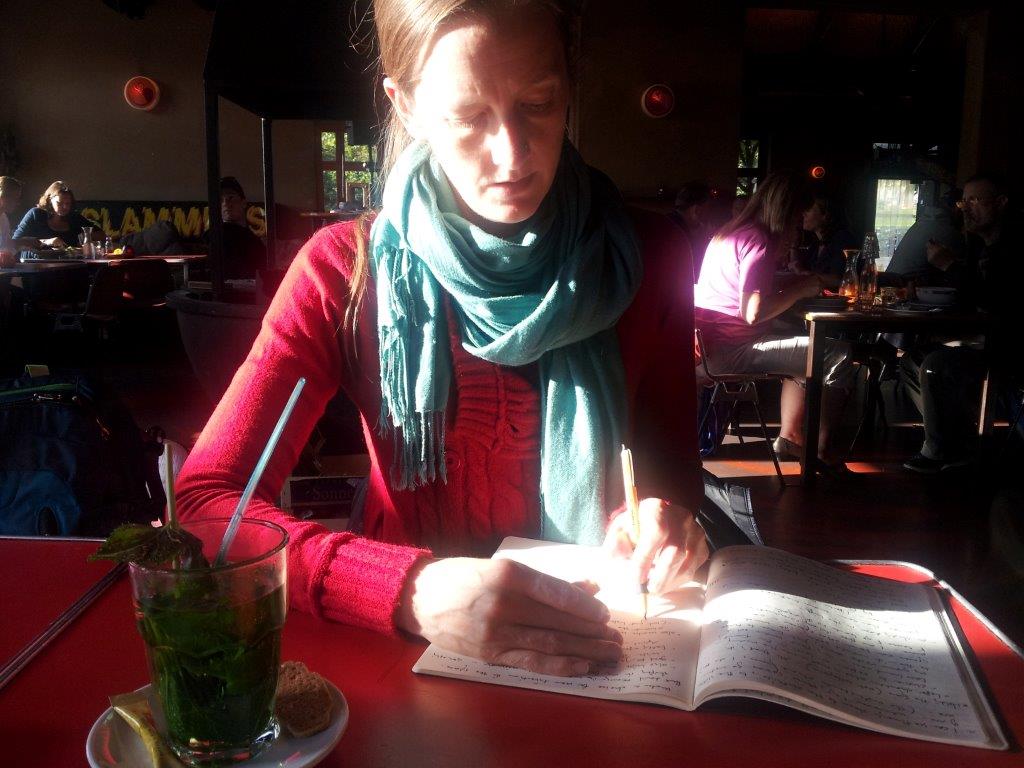
On Writing #116 : Laressa Dickey


On Writing
Laressa Dickey


I.

Writing as a way toward innerness, an organ of innerness.
I am not just trying to be a human being.
What are we meant for?
As in, a body walks into the world.
We are transmitting, performing, a mouthed thing into the world.
Is there humor in this story?
I know what to do in my innerness.
Language is the presence of watching and being watched.
A voice walks into a room.
The speaker is leaning heavily on their left leg and this can be heard through the folds of the vocal cords.
There was a moment when the container led to content.
Or reader, in your terms, there was a moment when the form made the content.
But first, there was motion.
There was inside and outside.
Then came up and down.
All this because of a midline, then multiple points of resistance.
There are joints between the bodies.
The speaker on their left leg and the hearers now.
I saw the back of his body disappear through the door down a long hall, his left shoulder drooping.
The hallway a dark panelling, fashionable in the late 70s, somebody got a good deal on that.
I felt as if they were connected, the man walking away, left shoulder drooping, and the sadness as I remembered him lacing up his shoes in the morning before he left to go to work.
He was a young man then.
He was a young man thinking of this list: get gas in the car, pump up the tires, punch in, start the computer, sell sell sell, repeat repeat.
Before there are too many of you, standing with hands in pockets, let me say
My lavender is dead, has died.
It was his garden before it was mine.
To affect the future of the yet unborn.
That’s what’s for breakfast, friends.


II.

What is the poem? Is it having all the parts, being published, overt, checking the list? What about my friend whose life is consumed by caring for her small children? Or the one who cares for their dying parent? What about those? Are they the poem? Is life the poem? The transformation and breath of sap moving up and down, x times a day, feeding itself? The world is so loud you can barely hear it, the poem. Why do we keep on? In my partner’s native language (Farsi), there’s a phrase I love, which roughly translates, sometimes you ride the saddle, sometimes the saddle rides you. It’s like this with poems, maybe one kind of rhythm. It’s coming to you, you’re ready for it; you miss each other traveling in opposite directions.


III.

Crippled by that adage, write if you have something to say.

What?

No one talks only if they have something to say.
If only!
What about not saying what you have to say?
Say nothing.
Is that the poem?
Or saying something inside of saying nothing?

Writing as a space keeper; silent space; missed chances.

Writing as a failure to be in the made world with its noise.


Laressa Dickey [photo credit: Lily Kiara] is a writer based in Berlin. She's the author of several chapbooks including A Piece of Information About His Invisibility and apparatus for manufacturing sunset, and the poetry collection Bottomland (Shearsman). Two books are forthcoming: Roam (Shearsman) in 2016, and Twang (Backwaters Press) in 2017.

Tuesday, December 06, 2016

Recent reads: "Vesper Vigil" by Bronwen Tate

Vesper Vigil by Bronwen Tate
Published by above/ground press, 2016.


"You sleep, I sigh, we mingle breath like lovers –
I reach a stealthy hand, adjust the sheet.
Somewhere between sentiment and complaint
are words to name the child sleeping here"


So begins Vesper Vigil, a collection of sonnets which chronicle the last weeks of Bronwen Tate’s pregnancy with this perfectly succinct ambiguity – how it feels to be pinned down by what we love most. True to her intent, Tate records both the daily parenting of her young son and the approaching birth of her daughter without getting precious or irate. Instead, she employs a tenderness that seesaws between love and pain, gentle yet sore to touch.


“Will this lumpy baby ever come out?”
Owen considers, replies “I don’t know”.
So we measure days in peaches, bruises,
bruised peaches, it’s the body that chooses."


Tate explores the fragile limits of our bodies – how we feed, grow and injure them – within the framework of domesticated routines that gauge her excruciating wait. Every seemingly casual digression probes one of two spectres, the impending pain or joy. They’re a package deal, of course, and her bittersweet tone acknowledges it. Like the development of a fetus, these sonnets mature in nerves that feel deeply rooted thanks to the sing-song rhyme scheme. Each page can encapsulate hours or weeks. Her choice of form allows that compression rate without sacrificing a fluid rhythm, though – as is common with the sonnet – rhymes occasionally raise an eyebrow. (Did she really play disco, or does it just rhyme with San Francisco, etc.?) In any case, by the time she’s admitted to her hospital room, the anxiety and loneliness of third-trimester pregnancy is palpable:


"I’ve taken Misoprostol, Cervidil,
now sitting, watch contraction numbers rise,
one hand to hold the heart monitor still,
slight lag between the pain and peaking highs.
We left with early fog but found no bed,
paced corridors and watched the shifting crane,
took Owen to a playground, sat and read,
called only to be postponed again.
At two at last they showed me to my room,
this prison of uncertain duration,
can’t leave these walls till baby quits the womb,
perch on window bench, await dilation.
Alone now, I breathe through pains, try to sleep.
The road to you be gentle, dark, and steep."


Reading the above selection, I realize how little I’ve contemplated the psychological effects of pregnancy and childbirth. (Just analyzing Tate's thought that, once admitted, she cannot leave the hospital without first enduring an unknown pain gives my pulse a race.) As someone who looks in on parenthood from the outside, that’s my biggest takeaway from this chapbook. Tate manages to imbue archetypal family dynamics with a memorable dose of personal details, creating an unguarded glance at motherhood in transition.

Friday, December 02, 2016

On Writing #115 : kevin mcpherson eckhoff

On Writing, its Opposites, and Practical Methods for Embracing the Mawkish Thralldom of the Day-to-Day
kevin mcpherson eckhoff


No.


kevin mcpherson eckhoff loves poetry parties and saying “Me me me, me memememe … mmmmm.” Forge and rhapsodomancy are his fault, as are the final issues of dANDelion magazine and Open Letter, guest edited with his bff, Jake “The” Kennedy. Sorry! BookThug published Merz Structure No. 2 Burnt by Children at Play. Check it! Out! Library-style! When kevin’s not teaching at Okanagan College, he hangs out with a Laurel and two kiddos, sometimes cuddling at the Starlight Drive-in during a full moon in July or dipping into Halfway Hotsprings during a light February snowfall. Oh, and you can catch his face as “Tall Security Guard” in the film Tomato Red.

Thursday, December 01, 2016

We Who Are About To Die : Elaine Woo

The two different questions of what constitutes freedom and does adversity build character intrigued Elaine and are examined in her second manuscript.  How much freedom do we really have when the state monitors our emails and phone calls and builds intricate profiles of us?  How do we find freedom despite all that?

Elaine Woo's second poetry collection continues to look through the framework of mythology, as does her first book, Cycling with the Dragon, Nightwood Editions, 2014.

Where are you now?
Good question.  In the early weeks after the US election, my initial impulse was to curl up in a fetal ball and hide in bed to await the end of days.  But after speaking with Canadian friends and relatives residing in America, I decided, more than ever, now is the time to speak out and resist.  And, I have begun through my writing.

I read Trump is stripping funding for NASA climate research when polar glaciers are melting at a rapid pace and the Global Mean Sea Level has risen 4 to 8 inches in the past century.  Perhaps, if he has any beachside holdings, he might reconsider were it to flood.

The CanLit furor has proved just as divisive.  With so many divergent views, bridging  is ever more desirable.  We need calm discussions and perhaps agree to disagree.

What are you reading?
The Errancy (poems) by Jorie Graham.  I'm not very far into the book but hugely admire her craft and depth.

What have you discovered lately?
Firstly, the joy of less.  Secondly, any time is cause for celebration.

The appreciation that all people are imperfect.

Where do you write?
I've been invited to join writing groups as well as to facilitate writing groups but feel most comfortable at my ancient teacher's desk, surrounded by books by authors I admire, student prints, and photos of loved ones.

What are you working on?
A second manuscript about human foibles.  One day while reading an anthology of classical mythology, it struck me to use the Greek gods and the Monkey King of Chinese mythology to represent humans in fictitious exploits.

Have you anything forthcoming?
I have 3 pieces coming out in CWILA's S/tick.  One is a graphic comic:  a conversation about the very real power struggle in many relationships. The other two are poems inspired by firstly, a female duck chastising 3 mallards at a local bird sanctuary and secondly, a night looking at celebrity stories online.

What would you rather be doing?
Nothing else.  I write for the joy of writing.


Birth


                          Blue skies agitate, streak, marble with black and silver

Gaia’s gauze-sheathed breasts fall upon Uranus’, his iron manhood slips in her well.  Geysers erupt, cloud banks curdle.  Hurricane current of DNA, monster strands

unravel, wreaks debris of monolithic creatures, twelve Titans, including Cronus, Rhea, and Iapetos, fifty headed and hundred armed Hecatoncheires and Cyclopes, wailing bricks of pain


                   Pater Familias rams their mutant


                                                       progeny in mother’s yawning


                                a mucosal, veiny pink abyss


                                                                              She, red-raging, turns


    A fiction?  Battered, Titans, Cyclopes, and siblings


                                                            confined, wince, cringe


nails breasts, rousingly roar for “MORE”


It Takes Imagination


Unfurling reel:

                                beasts’   eyelids squintered


                     unfurl a scale obstinate                          another


                                                                                               and another


                                    flame of throat kiln


         firing dialogue between brain and tongue


                                                                     winch hefty boulders


                         ignite language of ochre comfort in toil


 “a challenge to suffer bravely”1       


                                                            shoulder isolation, multi water pots atop head


       labour heroically


                                                         slave against hatred


                                                                                            split anguish gruel


                                                                  faint pink amity horizon perceptible

warms brows earthen


                                       ushers in hushed peace


                     clambering out of captivity, a fantasy still?


Thursday, November 24, 2016

On Writing #114 : Craig Santos Perez


On Writing from the New Oceania
Craig Santos Perez

1.       Write from: 

From indicates a particular time or place as a starting point; from refers to a specific location as the first of two limits; from imagines a cause, an agent, an instrument, a source, or an origin; from marks separation, removal, or exclusion; from differentiates borders. Where are you from?” In the preface to my first book of poems, I wrote: On some maps, Guam doesn’t exist; I point to an empty space in the Pacific and say, ‘I’m from here.’ On some maps, Guam is a small, unnamed island; I say, ‘I’m from this unnamed place.’ On some maps, Guam is named ‘Guam, USA.’ I say, ‘I’m from a territory of the United States.’”

from excerptus: pluck out” from ex- out” + carpere gather” or harvest”

From also indicates an excerpt or a passage quoted from a source. My own passage and migration from Guam to California often feels like living an excerpted existence; while my body lives here, my heart still lives in my homeland. Poetry is a way for me to bring together these excerpted spaces via the transient, processional, and migratory cartographies of the page. Each of my poems, and each of my books, and seemingly every breath I take, carries the from and bears its weight and incompleteness.

2.        Write Oceanic

The imagination is an ocean of possibilities. I imagine the blank page as an excerpt of the ocean. The ocean is storied and heavy with history, myth, rumor, genealogy, loss, war, money, the dead, life, and even plastic. The ocean is not aqua nullius.” The page, then, is never truly blank. The page consists of submerged volcanoes of story and unfathomable depths of meaning.

Each word is an island. The visible part of the word is its textual body; the invisible part of the word is the submerged mountain of meaning. Words emerging from the silence are islands forming. No word is an just an island, every word is part of a sentence, an archipelago. The space between is defined by referential waves and currents .

Oceanic stories are vessels for cultural beliefs, values, customs, histories, genealogies, politics, and memories. Stories weave generations and geographies. Stories protest and mourn the ravages of colonialism, articulate and promote cultural revitalization, and imagine and express decolonization.

3.       Write Archipelagic

An individual book is an island with a unique linguistic geography and ecology, as well as a unique poetic landscape and seascape. The book-island is inhabited by the living and the dead, the human and the non-human, multiple voices and silences. The book-island vibrates with the complexity of the present moment and the depths of history and genealogy, culture and politics, scars and bone and blood.

A book series is an archipelago, a birthing and formation of book-islands. Like an archipelago, the books in an ongoing series are related and woven to the other islands, yet unique and different. Reading the books in a series is akin to traveling and listening across the archipelago.
Because Guam is part of an archipelago, the geography inspired the form of my from unincorporated territory book series. Additionally, the unfolding nature of memory, learning, listening, sharing, and storytelling informed the serial nature of the work. To me, the complexity of the story of Guam and the Chamorro people — entangled in the complications of ongoing colonialism and militarism — inspired the ongoing serial form.

The first book of the series, from unincorporated territory [hacha] (2008) focused on my grandfather’s life and experience on Guam when the island was occupied by Japan’s military during World War II. The second book, from unincorporated territory [saina] (2010), focused on my grandmother’s contrasting experience during that same period. The third book, from unincorporated territory [guma’] (2014) echoes and enlarges the earlier books through the themes of family, militarization, cultural identity, migration and colonialism. Furthermore, [guma’] focuses on my own return to my home island after living away (in California) for 15 years. I explore how the island has changed and how my idea of home has changed. I also meditate upon the memories that I have carried with me, as well as all that I have forgotten and left behind.

The titles are meant to mark and name different books in the same series. Just as an archipelago has a name, such as the Marianas Archipelago, each island of the archipelago has its own unique name. The names can be translated as [one], [elder], and [home]. My first book was given the name, [hacha], to mark it as the first book, first island, first voice. While one might expect the second book to be named, second, I chose the name, [elder], to resist that linearity and instead highlight genealogy, or the past. The third book, which means house or home, was an attempt to weave together time and space (the house or book as spatial and temporal). The fourth book, from unincorporated territory [lukao] (forthcoming, 2017) includes themes of birth, creation, parenthood, money, climate colonialism, militarization, migration, and extinction. The Chamorro name of the book, [lukao], means procession.

My multi-book project also formed through my study of the long poem”: Pound’s Cantos, WilliamsPaterson, H.D.’s Trilogy, Zukofsky’s “A, and Olson’s Maximus. I loved how these books were able to attain a breadth and depth of vision and voice. One difference between my project and other long poems” is that my long poem will always contain the from,” always eluding the closure of completion.

I also became intrigued by how certain poets write trans-book poems: such as Duncan’s Passages” and Mackey’s Songs of the Andoumboulou.” I employ this kind of trans-book threading in my own work as poems change and continue across books (for example, excerpts from the poems from tidelands” and from aerial roots” appear in both my first and second books). These threaded poems differ from Duncan and Mackey’s work because I resist the linearity of numbering that their work employs.

4.       Write Cartographic

I use diagrams, maps, illustrations, colalge visual poetry as a way to foreground the relationship between storytelling, mapping, and navigation. Just as maps have used illustrations (sometimes visual, sometimes typographical), I believe poetry can both enhance and disrupt our visual literacy.

One incessant typographical presence throughout my work is the tilde (~). Besides resembling an ocean current and containing the word tide” in its body, the tilde has many intriguing uses. In languages, the tilde is used to indicate a change of pronunciation. As you know, I use many different kinds of discourse in my work (historical, political, personal, etc) and the tilde is meant to indicate a shift in the discursive poetic frame. In mathematics, the tilde is used to show equivalence (i.e. x~y). Throughout my work, I want to show that personal or familial narratives have an equivalent importance to official historical and political discourses.

Cartographic representations of the Pacific Ocean developed in Europe at the end of the 15th century, when the Americas were incorporated into maps: the Pacific became a wide empty space separating Asia and America. In European world maps, Europe is placed at the center and Oceania” is divided into two opposite halves on the margins. As imperialism progressed, every new voyage incorporated new data into new maps.

As I mention in the preface to my first book, the invisibility of Guam on many maps—whether actual maps or the maps of history—has always haunted me. One hope for my poetry is to enact an emerging map of Guam” both as a place and as a signifier.

The actual maps” in my first book are, to me, both visual poems and illustrations of the rest of the work. In my imagination, they function in two ways: first, they center Guam,” a locating signifier often omitted from many maps. Second, the maps are meant to provide a counterpoint to the actual stories that are told throughout the book. While maps can locate, chart, and represent (and through this representation tell an abstracted story), they never show us the human voices of a place. I place this abstract, aerial view of Guam” alongside the more embodied and rooted portraits of place and people.

Song maps” refer to the songs, chants, and oral stories that were created to help seafarers navigate oceanic and archipelagic spaces. Pacific navigational techniques are often understood as a visual literacy,” in the sense that a navigator has to be able to read” the natural world in order to make safe landfall. The key features include reading the stars, ocean efflorescence, wave currents, and fish and bird migrations.

Scholars and navigators describe this technique as moving islands” because in these songs, the canoe is conceptualized as remaining still, while the stars, islands, birds, fish, and waves all move in concert. Islands not only move, but islands also expand and contract. For example, if you see an offshore bird associated with a certain island, then you know that island is nearby (thus, it has figuratively, expanded).

With this in mind, I imagine that poems are song maps of my own journey to find Guam across historical and diasporic distances. I imagine the reader is in a still canoe, reading the songs in order to navigate the archipelago of memory and story. In this way, books and words become moving islands, expanding and contracting, inhaling and exhaling.


Craig Santos Perez is a native Chamorro from the Pacific Island of Guam. He is the author of three books, most recently from unincorporated territory [guma’], which received an American Book Award 2015. He is an associate professor in the English department at the University of Hawaiʻi, Mānoa. You can find him on Facebook, Twitter and here: www.craigsantosperez.com.