On Writing
Aaron Tucker
I struggle sometimes to describe my own writing because I spend a lot of time thinking about how to try to teach others how to write. On the one hand I push a very programmatic and pragmatic approach which involves a sort of template-algorithm system of syntaxed gears and dictive cogs; writing is response to some basic ideas of genre and audience expectations. It is a lot of the same components driven by specific authorial choices that then elaborate into different communication machines that, despite their intricate differences, are all the same thing: communication machines, each one. An essay is a poem is a novel. It is here that repetition becomes the most important tool. Repetition here is the part that allows for a faster, cleaner machine, one that whirls instead of chugs. Repetition is the habitual that eventually turns typing into craft. Repetition is work and with each return loop, writing gets an incredibly tiny bit easier, a miniscule amount more transparent.
I struggle sometimes to describe my teaching because I spend a lot of time thinking about how to try to write to others. On the other hand I try to read far, far more than I write. I admire in others how a sentence or line can fulcrum with a small precision that reveals the larger impulse behind it. It is in those larger gestures that the machinations of a metaphor emerge, what bpNichol would call an exit or an entrance, what Ondaatje sees as Billy’s “beautiful machines pivoting on themselves,” machines under the tension of being simultaneously microscopic and macro-universal. It is here that repetition becomes the most important tool. Repetition here is the part that allows the reader a sturdy home to return to, a body of familiarity built from the cells of prepositions and nouns, the embryonic spilling of adverbs. Repetition is the mutation that walks out of an ocean. Repetition is joy and with each return loop, writing gets a tiny bit more mysterious, a miniscule amount more rewarding.
I struggle sometimes to describe my typing because it’s as messy and as personal as my scribbled longhand. I learned how to type on a lap-sized red machine that blinked letters and beeped when I punched the right key. Now I drift, fingers in bunches and never homerow, still struggling to look at the screen even when I’m uploading some part of my brain and/or face. It is here that repetition becomes the most important tool. Repetition here is the assemblages of avatars that weave in and out of an Internet user. Repetition is the copies of pages pulled from servers and brought back to me. Repetition is typing “the” as: left hand - middle finger “t”, index finger “h” then ring finger “e”. Repetition is virtual and with each return loop, writing gets a tiny bit more networked, a miniscule amount more intimate.
I struggle sometimes to admire the other hand, where the left is a template for the right and my fingers repeat ten times. Surely there is an audience who expects. Surely there is a genre simultaneously impulsive and clean. The components are pivoting, the fulcrums are algorithmic and the avatars are a space/sea craft aimed at the long loop of a return celestial/ocean voyage. It is here that repetition becomes the most important tool. Repetition here is the part of the walk that pauses before a sturdy metaphor. Repetition is a transparent noun. Repetitive is a potentially pragmatic adverb. Repeating gets a tiny bit more intricate, more joyous, more habitual with each essay or poem or novel.
Aaron Tucker’s poetic works and reviews have been published across Canada. His chapbook, apartments, was shortlisted for the 2010 bpNichol Chapbook award. His current project, tentatively titled punchlines, is moving ever slowly forward, with the most recent iteration released by above/ground in summer 2013. In between all this, he has a regular podcast over at poetryadventure.ca
His collection of essays Interfacing with the Internet in Popular Cinema is going to be published by Palgrave-Macmillan in the summer of 2014.
In addition, he is a professor in the English department at Ryerson University where he is currently teaching essay writing and digital literacy to first year students.
He is working on learning chess in between watching his beloved Raptors lose games. You can reach him atucker[at]ryerson[dot]ca
covering ottawa writing, writers, events and publications; curated by rob mclennan,
Friday, November 01, 2013
Saturday, October 26, 2013
POETS' PATHWAY UNVEILING
INVITATION
MONDAY OCTOBER 28, 2013, 2 PM.
for
BENJAMIN SULTE
PROLIFIC and VIBRANT POET, JOURNALIST, and HISTORIAN OF 19TH CENTURY OTTAWA
THE RIDEAU RIVER, SOUTH OF PRINDIVILLE STREET.
with
COUNCILLOR OF RIDEAU-VANIER, MATHIEU FLEURY
AUTHOR and HISTORIAN, JEAN YVES PELLETIER
POET, MICHEL THERIEN
POET and STUDENT, ADELE KEYES
RECEPTION FOLLOWING at
EL MESON, 94 BEECHWOOD AVE.
MAP OF THE SITE AND DIRECTIONS:
VANIER PKWY, WEST ON QUEEN MARY ST., SLIGHT LEFT ON NORTH RIVER ROAD TO PRINDIVILLE. STREET PARKING.
.
Monday, October 21, 2013
On Writing #13 : Sean Johnston
On writing
Sean Johnston
I have always known there was something special about a community of writers, and I have found the support of many writing communities beneficial. But I have always been troubled by publicly identifying as a writer. This unease has been with me my whole life.
Too often the word community ends up excluding. That is, there are passwords and catch phrases that allow us entry or deny it. All communities have them and writing communities are no different. You enter a new one and suddenly an unfamiliar name is used in conversation to demonstrate authority or convey the speaker’s access to the inner circle. You have to know new names to be included. Even Joe Smith, someone might say, didn’t get a grant this time, even Joe, as if he is the gold standard.
So you go and read the work of this person, Joe Smith, which exists in many copies at various branches of the library and you see that no, he is not someone you should have known before moving to this community; he is an average writer of some local renown and that renown comes likely from his facility with teaching local young people about writing.
But in the exchange that led you to your assessment of the work of Joe Smith you have gotten to the heart of what discourages – that the intimacy between writer and reader is properly anonymous and that how you want to approach this community of writers is as a reader, not as a fellow writer. What happens when you empty a book in one single sitting on those rare occasions when you have the time and the right book and the solitude is something that is private, really. It is a communion with your own imagination, brought on by the recitation of another’s similarly private engagement with their own imagination. The book and the reader are emptied. The ego is gone. There is total surrender. Then soon afterward the ego enters again as you rearrange the blocks of your life after the book has changed you.
It’s too hard to be honest about this in public. When you sit at a reading, if you are moved then what follows is embarrassment—you were alone and naked while this stranger beside you had her own unknown experience and now you politely nod as if the intimacy you’d shared just heartbeats ago was not intimacy at all, and you have not changed. If you are not moved you have just seen someone dance naked, or play with props, or wear something garish, and you are forced to pretend all is normal, this is adult behaviour, nothing is wrong. And you leave into the darkness depressed, because you feel like a liar. It’s like a racist joke has been told and though you did not laugh, neither did you voice your disapproval.
We have built a new church and it’s just the same as the old. When we talk about writing there is an element of the testimonial, of the redemption story, and there is something evangelical about its promotion. But in “How to Speak Poetry,” Leonard Cohen writes: “Respect the privacy of the material. These pieces were written in silence.”
I know that when I say these things they can easily be misread—or maybe that I misread them as any human does, trying to cast myself as the hero in whatever story I tell. It seems arrogant, it seems that my reticence stems from some not-so-hidden belief that I am somehow more devout in my application to this art’s demands than everyone else. But I know it’s not exactly a virtue. I know it’s also a kind of miserly guarding of my own energy in ways that mentors I’ve encountered along the way seemed, thankfully, to avoid.
The way to do it maybe is to talk about the work of someone you admire and somehow in the process describe yourself. But if you look that thing in the face you find you can’t believe it. It’s not true, so you fall 100 metres like Wile E. Coyote. Who can ever speak of Kafka or Barthelme knowing he does it as a way of speaking of himself?
So if you can think of something that is not writing, then do that. I admire someone who bakes or cooks and cleans as he goes, because I cannot. Old smooth concrete that’s clean. A lawn that’s like felt on certain nights as you drive up and your headlights sweep over it.
This is portable. I admire the man who walks slowly and earnestly, to the best of his ability, with his backpack full, to some weekly appointment I cannot imagine. I don’t know what he may do.
That’s love for you, he’ll say, and mean it.
Now I am back to the problem: I am not as free of cynicism as that man is. He has a real-life counterpart. I saw him in South Dakota, in a launderette and one of his shoes was horribly large and misshapen. He was silent, and his companion was a thin man who looked about my age, though his face was older, and spoke a lot, often repeating himself. He’d say things like “Lived all my life in a college town, never did go to college.”
Who am I to him? Mine is a life of privilege, and though I remember the jobs I had where I was cold and wet and tired, and though they lasted about 20 years and at the time seemed as if they would never end, these days I am warm and dry and if I am writing this I have cleared enough space and time to be alone with my thoughts, and to read. So is it possible to apply the effort that man with unequal legs applies as he walks in the heat to some appointment in which, whether duty or recreation, he finds pleasure? It is not.
Nothing in my life is clean. It is unclean not in the way of some disease, but in the way of an unmade bed and books unfinished. I can untidy. I can’t tidy. I am useless. I have made no clean breaks in my life. What clarity I find, I try to mark down, and sometimes it stays clear, but often it doesn’t.
I respect that same effort in the work of others, but I prefer to be alone when I discover it. I give away books by authors I admire, but still feel somehow as if I’m not doing my part.
Then just as I was going to send this off, another example appears: UBC announces a writing prize, which is lauded on social media by someone I admire, and someone who is tireless in his support of art and culture in Vancouver. But the prize, while sounding good, is nothing. It consists of a contract with a literary agency and also with a publisher. That’s great, but it’s a prize that is open to only UBC students and alumni, so it is simply formalizing something that is done informally anyway, and its purpose is not to give one more writer a chance (if this were really the purpose, it would be open to people from all schools or from outside of the creative writing factory completely)—it’s purpose is to get publicity for the school, the agency, and the publisher for something they already do. And while it’s true that UBC has nurtured many writers, it’s also, of course, home to huge creative writing classes in large lecture halls. There is no pedagogical justification for this approach to creative writing; the only motivation is financial, of course, and perhaps it can be justified in some way by its subsidization of the workshop classes that follow in the upper year classes, but I don’t think so.
Anyway, this popped up on my screen while I was worrying about my goodreads profile. Should I remove certain books that I rated poorly before identifying myself as the author of my books? Would it hurt me later to have rated poorly a book by a publisher with whom I would like to publish? Would it cause certain authors to rate my new novel poorly and would that even be that bad, as long as they gave it a rating? Does anyone read these things anyway?
I don’t know, but it reinforces the difficulty I have with belonging to this larger community of writers. I don’t want to hurt people. I like them. I know them as friends. But then they write books, and how do I read them as I should properly, as books written by strangers?
Sean Johnston's latest book is the novel Listen All You Bullets (Gaspereau, 2013). He's also the author of The Ditch Was Lit Like This (Thistledown, 2011), All This Town Remembers (Gaspereau, 2006) and A Day Does Not Go By (Nightwood, 2002), which won the 2003 ReLit Award for short fiction. He lives in Kelowna, BC, where he co-edits Ryga: A Journal of Provocations and teaches at Okanagan College.
Sean Johnston
I have always known there was something special about a community of writers, and I have found the support of many writing communities beneficial. But I have always been troubled by publicly identifying as a writer. This unease has been with me my whole life.
Too often the word community ends up excluding. That is, there are passwords and catch phrases that allow us entry or deny it. All communities have them and writing communities are no different. You enter a new one and suddenly an unfamiliar name is used in conversation to demonstrate authority or convey the speaker’s access to the inner circle. You have to know new names to be included. Even Joe Smith, someone might say, didn’t get a grant this time, even Joe, as if he is the gold standard.
So you go and read the work of this person, Joe Smith, which exists in many copies at various branches of the library and you see that no, he is not someone you should have known before moving to this community; he is an average writer of some local renown and that renown comes likely from his facility with teaching local young people about writing.
But in the exchange that led you to your assessment of the work of Joe Smith you have gotten to the heart of what discourages – that the intimacy between writer and reader is properly anonymous and that how you want to approach this community of writers is as a reader, not as a fellow writer. What happens when you empty a book in one single sitting on those rare occasions when you have the time and the right book and the solitude is something that is private, really. It is a communion with your own imagination, brought on by the recitation of another’s similarly private engagement with their own imagination. The book and the reader are emptied. The ego is gone. There is total surrender. Then soon afterward the ego enters again as you rearrange the blocks of your life after the book has changed you.
It’s too hard to be honest about this in public. When you sit at a reading, if you are moved then what follows is embarrassment—you were alone and naked while this stranger beside you had her own unknown experience and now you politely nod as if the intimacy you’d shared just heartbeats ago was not intimacy at all, and you have not changed. If you are not moved you have just seen someone dance naked, or play with props, or wear something garish, and you are forced to pretend all is normal, this is adult behaviour, nothing is wrong. And you leave into the darkness depressed, because you feel like a liar. It’s like a racist joke has been told and though you did not laugh, neither did you voice your disapproval.
We have built a new church and it’s just the same as the old. When we talk about writing there is an element of the testimonial, of the redemption story, and there is something evangelical about its promotion. But in “How to Speak Poetry,” Leonard Cohen writes: “Respect the privacy of the material. These pieces were written in silence.”
I know that when I say these things they can easily be misread—or maybe that I misread them as any human does, trying to cast myself as the hero in whatever story I tell. It seems arrogant, it seems that my reticence stems from some not-so-hidden belief that I am somehow more devout in my application to this art’s demands than everyone else. But I know it’s not exactly a virtue. I know it’s also a kind of miserly guarding of my own energy in ways that mentors I’ve encountered along the way seemed, thankfully, to avoid.
The way to do it maybe is to talk about the work of someone you admire and somehow in the process describe yourself. But if you look that thing in the face you find you can’t believe it. It’s not true, so you fall 100 metres like Wile E. Coyote. Who can ever speak of Kafka or Barthelme knowing he does it as a way of speaking of himself?
So if you can think of something that is not writing, then do that. I admire someone who bakes or cooks and cleans as he goes, because I cannot. Old smooth concrete that’s clean. A lawn that’s like felt on certain nights as you drive up and your headlights sweep over it.
This is portable. I admire the man who walks slowly and earnestly, to the best of his ability, with his backpack full, to some weekly appointment I cannot imagine. I don’t know what he may do.
That’s love for you, he’ll say, and mean it.
Now I am back to the problem: I am not as free of cynicism as that man is. He has a real-life counterpart. I saw him in South Dakota, in a launderette and one of his shoes was horribly large and misshapen. He was silent, and his companion was a thin man who looked about my age, though his face was older, and spoke a lot, often repeating himself. He’d say things like “Lived all my life in a college town, never did go to college.”
Who am I to him? Mine is a life of privilege, and though I remember the jobs I had where I was cold and wet and tired, and though they lasted about 20 years and at the time seemed as if they would never end, these days I am warm and dry and if I am writing this I have cleared enough space and time to be alone with my thoughts, and to read. So is it possible to apply the effort that man with unequal legs applies as he walks in the heat to some appointment in which, whether duty or recreation, he finds pleasure? It is not.
Nothing in my life is clean. It is unclean not in the way of some disease, but in the way of an unmade bed and books unfinished. I can untidy. I can’t tidy. I am useless. I have made no clean breaks in my life. What clarity I find, I try to mark down, and sometimes it stays clear, but often it doesn’t.
I respect that same effort in the work of others, but I prefer to be alone when I discover it. I give away books by authors I admire, but still feel somehow as if I’m not doing my part.
Then just as I was going to send this off, another example appears: UBC announces a writing prize, which is lauded on social media by someone I admire, and someone who is tireless in his support of art and culture in Vancouver. But the prize, while sounding good, is nothing. It consists of a contract with a literary agency and also with a publisher. That’s great, but it’s a prize that is open to only UBC students and alumni, so it is simply formalizing something that is done informally anyway, and its purpose is not to give one more writer a chance (if this were really the purpose, it would be open to people from all schools or from outside of the creative writing factory completely)—it’s purpose is to get publicity for the school, the agency, and the publisher for something they already do. And while it’s true that UBC has nurtured many writers, it’s also, of course, home to huge creative writing classes in large lecture halls. There is no pedagogical justification for this approach to creative writing; the only motivation is financial, of course, and perhaps it can be justified in some way by its subsidization of the workshop classes that follow in the upper year classes, but I don’t think so.
Anyway, this popped up on my screen while I was worrying about my goodreads profile. Should I remove certain books that I rated poorly before identifying myself as the author of my books? Would it hurt me later to have rated poorly a book by a publisher with whom I would like to publish? Would it cause certain authors to rate my new novel poorly and would that even be that bad, as long as they gave it a rating? Does anyone read these things anyway?
I don’t know, but it reinforces the difficulty I have with belonging to this larger community of writers. I don’t want to hurt people. I like them. I know them as friends. But then they write books, and how do I read them as I should properly, as books written by strangers?
Sean Johnston's latest book is the novel Listen All You Bullets (Gaspereau, 2013). He's also the author of The Ditch Was Lit Like This (Thistledown, 2011), All This Town Remembers (Gaspereau, 2006) and A Day Does Not Go By (Nightwood, 2002), which won the 2003 ReLit Award for short fiction. He lives in Kelowna, BC, where he co-edits Ryga: A Journal of Provocations and teaches at Okanagan College.
Tuesday, October 15, 2013
Monday, October 14, 2013
Recent Reads: Gary Barwin and Monty Reid
Seedpod, Microfiche by Gary Barwin
Moan Coach by
Monty Reid
Both titles
published by above/ground press, 2013.
In the first,
numbered entry of Seedpod, Microfiche, Gary Barwin stakes himself some earth in
a local setting and issues a standpoint. The setting carries the calming air of
a park, some quaint greenspace barred at all sides by the infringing noise of a
city’s hustle, and Barwin articulates the scene as if transcribing the beats of
a field-recording. He’ll return to this spot repeatedly over the course of his
new chapbook – in spirit if not in person – toying with memory spores that organically
shift about.
“1
a
grass blade, a truck
a
small son
a
constellation
evolution
is an oblong song
the
fishes whisper
seedpod,
microfiche of twilight
a
dewdrop observed, a cobweb
a
weed-wrapped tongue or treetop
bulrush,
an art song
consciousness
a
fossil 8-track of the city
there
is, my love,
a
stethoscope whose end
is
nowhere
whose
earpieces
are
everywhere.”
Is Seedpod, Microfiche
a long poem exploring the conservation of one’s bearings or a half dozen
incarnations of that one twilight? It may read like a shrug when I say “both”
but Barwin does too good a job of balancing dual momentums here – one locked in
constant revision, the other evolving layer upon layer. As a series of memory
drafts substituting aspects of the plateau set in “1”, Seedpod, Microfiche puts
forth a playful tone. But as an episodic long-form poem, those word-swaps take
on a somber agency of their own, reflecting the aches of an aging timeline.
After “winter
makes smaller our small sun”, “3” goes on to say that “seedpod is the nape / of
springtime on the map of trees”. With seasons there are years unspooling
Barwin’s casual landscape, marked affectingly by the way his metaphor about
love and stethoscopes evolves. The youthful romanticism in “1” doesn’t harden
so much as loosen into vague uncertainties by “5”:
“an
experienced guide can follow
8-tracks
through the city
the
way a scientist follows
an
atom’s breath
love
like a stethoscope
with
neither ears nor heartbeats”
Possibilities
narrow into proofs. The whispering fish build a barbican; “a grass blade” becomes
“glass stuck in the foot”. The park is now seen through a different set of
eyes. Seedpod, Microfiche’s spectrum can be flipped through within minutes but
its brevity belies how a knack for the right words (and some alluring
omissions) can deepen an implicit narrative. So it is that Barwin’s “oblong
song” exists off the page, between renditions; his unassuming language like
tectonic plates opening a fissure that readers will think on long after the
last page.
“1.
She
was asked to be part of a production of the Vagina
Monologues
but after a couple of rehearsals they said she
wasn’t
convincing enough.
Convincing
enough at what, she thought? It’s your moan,
they
said, it needs some work.
You
have to moan as though you weren’t doing it for an
audience.
You’re going to need some help.”
You can admit
if you’re already hooked. The premise, matched with Monty Reid’s informal
storytelling, renders Moan Coach an immediate page-turner. It almost reads like
the beginning of a joke headed someplace dreadful but, by page two, Reid
commits a potential Saturday Night Live sketch to deeper concerns on
femininity, sexuality and authenticity – all twitching through the lens of a
demanding society.
It’s still
broadly funny, mind you, and Reid’s handling of semi-tragic themes remains
light and focused on the oblivious surface. In fact that casual tone seems
fitted with the task of keeping Moan Coach together, judging by the way Reid’s line-breaks
and punctuation defy any persisting discipline.
“9
She
was sleeping poorly.
Something
gathered in the corners of the ceiling, abandoned
skins
under the bed.
For
sure there was all that moaning. Yes, you were doing it again last night, said
her partner
I’ll
be in the spare room when you want me.”
It takes an
unwavering voice to guide Moan Coach’s readability without letting its aloof spirit
register as disinterested. And it no doubt helps that Reid’s protagonist, whose
sexual identity conforms to a series of male-supervised amendments, faces a highly
sympathetic problem: how can we express ourselves without fear of correction? And why
is individuality so often met with consternation instead of success? Questions
like these shudder like aftershocks well after opening night wraps in Moan
Coach, an engaging chapbook that sacrifices easy punchlines for thoughtful commentary.
Labels:
above/ground press,
Gary Barwin,
Monty Reid,
Recent Reads,
review,
Ryan Pratt
Sunday, October 13, 2013
STEVE McCAFFERY in A B Series!
A B Series Presents
A Reading and Performance by founding member of the Four Horsemen, author of more than thirty books and current David Gray Professor of Poetry and Letters at SUNY Buffalo:
STEVE McCAFFERY
8:00pm
October 19, 2013
Arts Court
Courtroom
2nd Floor
2 Daly Avenue
Ottawa, Ont.
Free
A hat will be passed.
More info: abseries.org
Steve McCaffery is the author of more than 35 books and chapbooks of poetry and criticism, most recently The Darkness of the Present (University of Alabama Press, 2012). Twice nominated for the Governor General’s Award, his many titles include: Paradigm of the Tinctures with illustrations by Alan Halsey (New York: Granary Books) and Slightly Left of Thinking. Poems and Postcognitions (Tucson: Chax Press). He teaches at the State University of New York at Buffalo where he is David Gray Professor of Poetry and Letters and Director of the UB Poetics Program.
A Reading and Performance by founding member of the Four Horsemen, author of more than thirty books and current David Gray Professor of Poetry and Letters at SUNY Buffalo:
STEVE McCAFFERY
8:00pm
October 19, 2013
Arts Court
Courtroom
2nd Floor
2 Daly Avenue
Ottawa, Ont.
Free
A hat will be passed.
More info: abseries.org
Steve McCaffery is the author of more than 35 books and chapbooks of poetry and criticism, most recently The Darkness of the Present (University of Alabama Press, 2012). Twice nominated for the Governor General’s Award, his many titles include: Paradigm of the Tinctures with illustrations by Alan Halsey (New York: Granary Books) and Slightly Left of Thinking. Poems and Postcognitions (Tucson: Chax Press). He teaches at the State University of New York at Buffalo where he is David Gray Professor of Poetry and Letters and Director of the UB Poetics Program.
Labels:
A B Series,
Arts Court,
Ottawa,
Ottawa events,
poetry,
Steve McCaffery
Ottawa Small Press Fair, Fall 2013
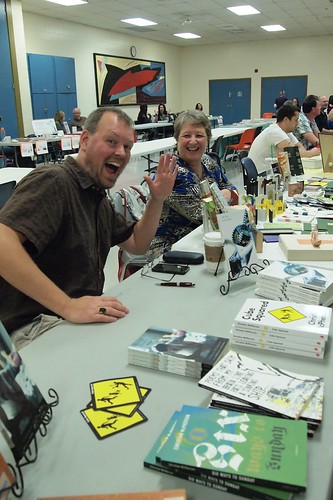
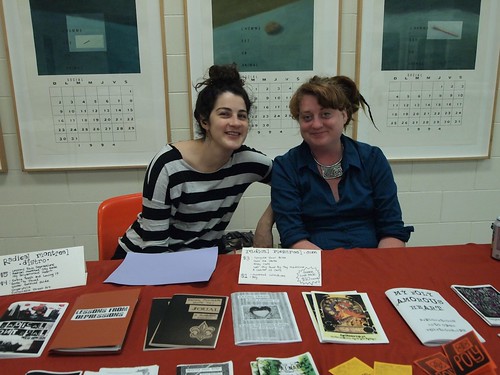
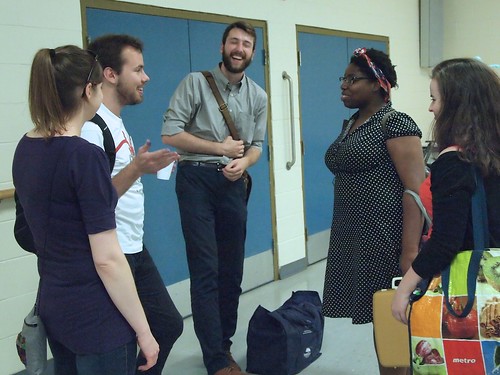
Welcome to the fair.Chris McPherson greets as Mary Kritz laughs.
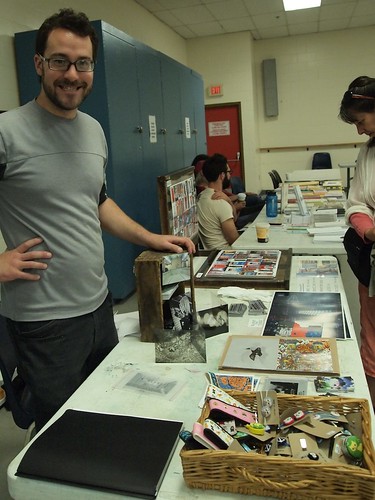
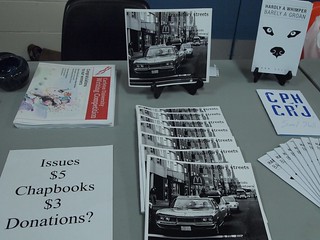
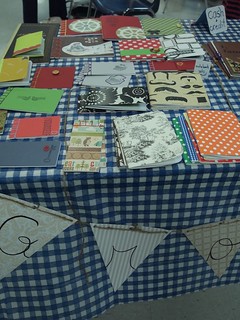
There's always loads to explore from poetry to punk, non-fiction to art pieces, handcrafted to materials, glossy to photocopy, kids books to magazines.
This year, Liana Voia did 2-3 minute interviews with various people with booths at the fair. Here is the interview with McPherson who does poetry and comic fiction of cubicle life, and the interview with Kritz who makes books and teaches people to make books.

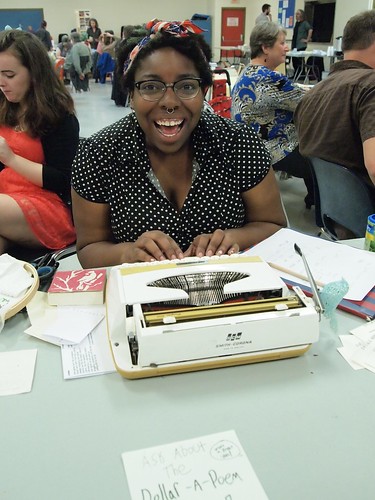
Around the corner Kimberley Dawkins was typing a poem for a dollar and selling copies of the Chrysalis Zine. Here's her interview.
It felt kind of weird not having a booth but going to and fro and chat and buy without having to watch for customers was nice too.
Matthew Thomson interviewed on his work, and that on his table of Dinah Zeldin, Rian Desourdie, Instant Crimson, as well as Mandi Morgan and Guillaume Vallée of the collective Organes Variables.
Similarly visual, and also from Montreal, are books by Edition Trip with a mixture of visual art and graphic novels, and collage art. Here's the interview with Stanley Wany.
Also coming from away, the Buffalo people who were the featured readers in the pre-fair reading Jeannie Hoag and Brian Mihok representing SunnyOutside Press. Many kinds of physically wonderful and ideas complex books.

Also in from Montreal zines from Radical Montreal of zines on cycling and thinking left of self-centred. The interview with Sheena Swirlz. (If I'd had the other bun, I'd have the 40 cents I was short for that one on eating clean, ironically enough.)

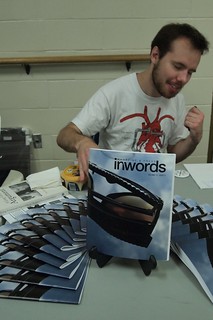
Local is In/Words with their new issue and chapbooks they've put out of their Carleton powerhouse. Watch the interview of Chris Johnson and J.M. Francheteau.

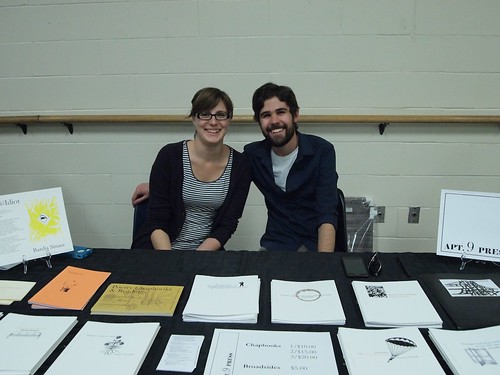
Jenn and Cameron of Apt 9 Press
The press has been going 5 years and feels like it's always been there. rob's press has been going 20 years. Their next launch is Oct 18th at Raw Sugar at 7pm.
At the other end of newness scale is R.M. Kozan whose Fresh Blue Ink is out its first publication. Andrew Simpson's first book Versus the Neanderthals was on hand too of about 60 flash fiction/short stories.

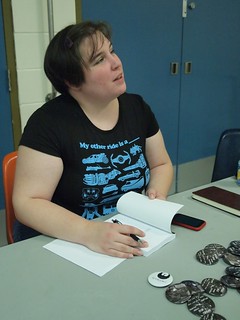
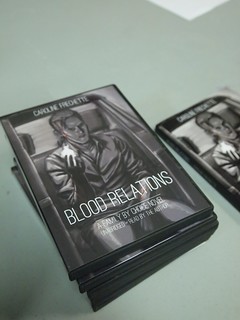
Caroline Frechette of Renaissance Book Press has copies, on digital or paper, and was happy to sign a copy.

Jessica Bebenek of Grow and Grow actually takes cash and credit. Most don't and I didn't notice until I was out of cash (again) and she was packing up.
I didn't end up making it all the way around the room. I missed at least half a dozen tables including Sheree Bradford-Lea who does cartoons on various things, mugs and paper.
Arc was represented by various shifts of people but Monty Reid and Jenny Hayson for the interview. And Bywords Online literary Magazine. Here's the interview with Amanda Earl of Bywords and AngelHouse Press.
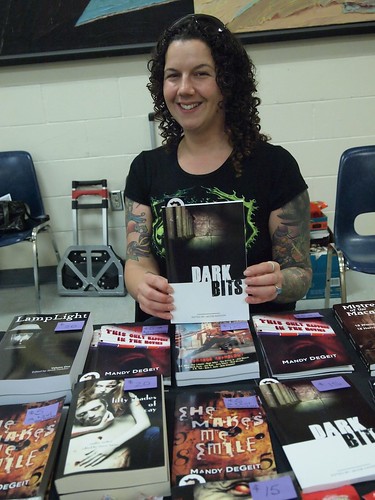
Mandy DeGeit's interview and her site.
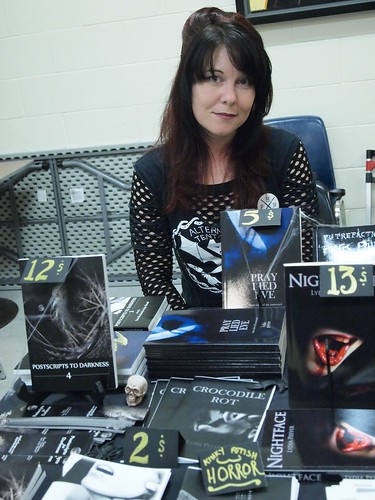
Lydia Peever's video and her press, NightFace of horror fiction.
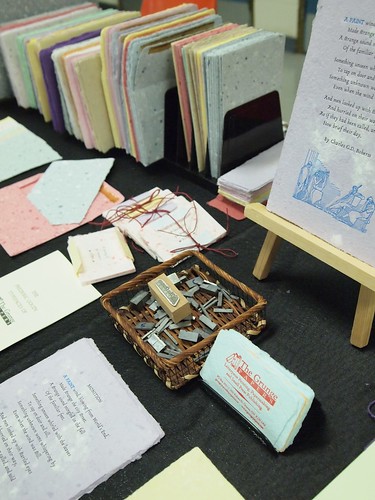
Grant Wilkins on his handmade papers and letterpress at Grunge Papers.
Voia ended up taking more interviews than I did photos. Here are ones with Kristin Groulx and John David Hickey with Groulx's wares, Jennifer Arbour Saint-Saëns, Dalton Derkson and Hurtin-Crue Press. There was a kid's books with a table was Charlie's Sparrow and the Secret of Flight by David Anderson and Monica and the Giraffe by Chani and Monica Dumont from The Success Room.
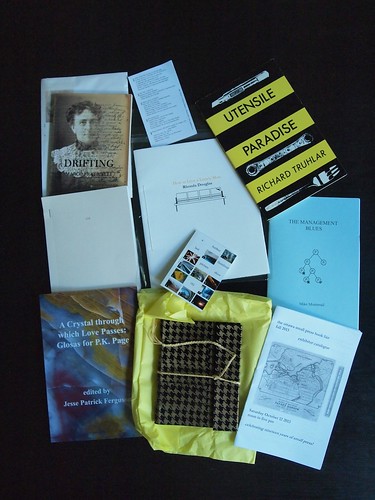
Some of my small press loot:

at 10 o'clock, Drifting by Marco Fraticelli (Catkin Press, 2013) which I've heard about for it seems like a year already, but it's been underway for 30 years. His sister Rina Fraticelli and he used found diaries from an abandoned house. The creative outcome for her was this BRAVO!Fact short film from a few years ago, Iron Hill. We'll talk about that book on an upcoming Literary Landscape. It is published by a new Ottawa Valley Imprint, Catkin by Claudia Coutu Radmore

At 12 o'clock, How to Love a Lonely Man by Rhonda Douglas (Apt 9 Press), Utensile Paradise poems by Richard Truhlar (from 1987 via Apt 302 Books), The Management Blues by Mike Montreuil (pictured). (At 4 o'clock) the exhibitor catalogue. (at centre clockface) a further last thumbnail picture show of fiction shorts from Adam Thomlison of 40 Watt Spotlight. Here's the Thomlison's interview.
At 6 o'clock) a handbound lovely notebook by Mary Kritz, a Crystal Though Which Love Passes, Glosas for PK Page by Jesse Patrick Ferguson (Buschek Books). It has a lot of writers in there that you would recognize, or should, including locals, Vivian Vivassis and Sandra Ridley. Here's the interview with John Buschek.
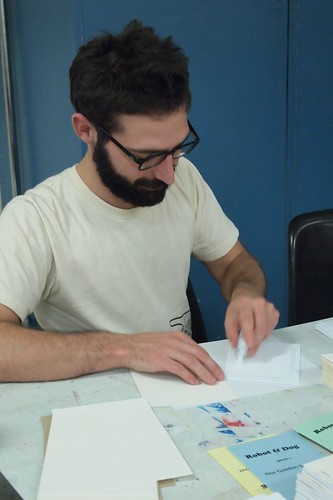
At 9 o'clock, iii by michael e casteels' puddles of sky press. I will buy everything he makes, or close to it, just like Apt. 9. here's the interview with Casteels who, below, is busily still assembling books whenever there's a lull.

Thanks to rob mclennan of rob mclennan generalamazingness. You can get above/ground subscriptions for 2014 now.

Packing up, cracking up, time to close the tables for another half year.
Tuesday, October 08, 2013
On Writing #12 : Ken Sparling
From some notes for a writing
workshop
Ken Sparling
“Something about how some
guys will dine you before laying on you something heavy.”
-from ‘blue toenails’ by
Golda Fried
what if the sentence began
and ended with “something”? there’s no good reason to do that, it’s just cool,
and if you could slip it past your reader: “Something about how some guys will
dine you before laying on you a heavy something.”
“Something about how some
guys will dine you before laying on you…”
“A word after a word after a
word is power.”
GARY LUTZ: With Gordon Lish,
who essentially said that if you want to write, you have to look into yourself
for what it is that distinguishes you from every other person on earth. It
might be something so. I just want to pursue what I learned from Lish, which is
to, well—he uses the word quiddity, which means that which distinguishes
someone or something from everybody else.
LUTZ: I write on the
computer, and in early drafts of my stories I use a very large type size—maybe
18, 20, that sort of thing—so that there aren't that many words on the screen
at one time. Then I can look very closely into the letters that constitute the
words—and I try to look at the typographical physique of one word and see how
it might interrelate to the word after it. As I get more into the drafts I use
a somewhat smaller type size. I like to be aware of what I'm writing—of the
physicality and materiality of the words—words simply as things, and I try to
divorce them as much as possible from their conventional meanings. I think it's
a way of forcing myself to divorce myself of any kind of journalistic approach
to writing.
Finally
the van was approaching the drive into the city and it could only encroach so
far. –Golda Fried (from Darkness then a
blown kiss)
the thing where you use a
thesaurus to get better words into your story/poem and you wind up with
something awkward. Golda plays this.
The
sun was still hurting even with the shades. But at least Wane couldn’t see my
eyes. My Salada eyes. The way he called them that. The way he showed me around
the kitchen, consumed all liquids. My Salada eyes. He wanted to milk them and
leave them white. My eyes widening on their way. –Golda Fried
My Salada
eyes. He called them that. He showed me around the kitchen. He consumed all
liquids. I smelled vinyl. Kitchen chairs. He wanted milk, so he opened the
fridge. Light. Five in the morning. We were still up to it. He tipped the
glass. Milk rode his upper lip. Milk my eyes, I told him. He wanted to leave
them white. My eyes were widening. We were on our way.
“the
overarching vision, or whatever you want to call it, in your story will become
apparent when you stop believing in it and it doesn’t disappear.” - from the
Philip Dick intro to I hope I shall
arrive soon
page
3: “The problem, then, is that if subjective worlds [words] are experienced too
differently, there occurs a breakdown of communication… and there is the
real illness.”
Each
word is a world that you’ve populated in your mind.
A lot
of the work I do involves disabling the mechanisms that hold a piece of writing
together. I didn’t make a conscious choice at any point in my career to do this
sort of work. And the only reason I can tell you about this is because I’ve
been doing it so long that I’ve been able to look back and detect some
patterns.
So,
for example, I take apart books…
Like I say, I didn’t come to this by choice, but I believe my intent in taking things apart is to make me feel as though I’m exercising a measure of choice in how I put things together - that how I put things together isn’t entirely determined by external factors. In other words, writing is a way for me to explore the possibility of acting freely, what that could mean, how it could come to manifest in the world.
Ken Sparling is a writer. Google him if you want to know more.
Friday, September 27, 2013
Recent Reads: After Swann by Marthe Reed
After Swann by
Marthe Reed
Published by above/ground press, 2013.
There’s a
surprising amount of perspective unifying Marthe Reed’s new chapbook. A collaged
piece intertwining Reed’s words with those of Marcel Proust (by way of his
Swann’s Way), it’s also an animated video produced in association with the
Plastic Theater of Lafayette. And when you consider this above/ground press
release appears excerpted from a larger body of work, which (one imagines) will
deepen already weighty themes of gender and consciousness, well, there is much
to chew on here.
Given all of
that context, After Swann surprises because it’s fully transporting on its own.
I jumped in as I usually do, obliviously – having read no “product
descriptions” in advance – and immediately felt the invisible parameters that directed acceptable female behaviour in an aristocratic setting; constraints that still loom
today.
“these
dreams
stop
like a clock
a
malady
too
irresistible
this
black cavity
precisely
the same
she
might have a red
principle
a
certain type of femininity
her
subjection
fixed
in
space
oh,
marvelous
the
tombs
of
sunlight straying
impossible
for me
the
vagrancy
of
her
detachment
that
face
deliberately
unfinished
present
except
in a
flood of blue light
that
current
we
imagine
almost
ours
that
sort of tenderness
the
instant of pain
the
special pleasure
and
seize
the
mysterious object
still
alive
buried
in a couch of grass”
From “21”,
Reed’s first chapter, we’re acclimatized to a code of conduct pillowed between
Freudian urges and bigoted expectation. Marthe Reed has tackled femininity in a
male-oriented society before and here it’s quietly rendered amidst the formality
of a Jane Austen-esque estate. There’s always the matter of evening
entertainment, of dresses and figurative masks to attend to, while the meadows hang like a
dreamscape just over property lines. From “27”:
“her
spirited
laughing
a
cataract”
drunken
with
scandal
and asseveration
like
a cage-bird”
Alongside our
nameless protagonist, we readers learn to cope within the strictly defined
rules that govern a gender and home we had no hand in. After Swann’s gaze
tenders no logical reasoning for our plight but no clear remedies either. These
stanzas steady themselves on perseverance, never acting on defiance or
self-pity. Womanhood, as sculpted by men, becomes a sentence to outlast and yet
Reed’s collage engrosses us with its daily tribulations.
Her lines,
which rarely exceed four words, huddle in clusters of threes over a
dispassionate timeline often fragmented by obligation and excess. Scarcely
placed details of these events welcome a share of guesswork while Reed’s lack
of punctuation rolls a mental fog over what happened, when, and whether it
matters.
After Swann's desensitized outlook cannot be empathized with through a veil of historical follies when femininity
remains smothered, to one degree or another, throughout the world. Like any
form of ignorance, sexism lowers the human condition and the few cases that make
headlines have typically been rooted, unseen and cancerous, for years. In the
Somali capital, it might justify treating women like possessions. In the posh office of Canada’s largest university, it may validate depriving students of the opportunity to read women’s voices. Somber truths like these underline the importance of After Swann’s character, which speaks for the
speechless through a collagist voice of both sexes. Unless you scour Proust’s
text in an attempt to dissect Reed’s patchwork, the voice surviving inequality,
one day at a time, is united regardless of gender. That's a comforting thought.
To close,
here’s an excerpt from “28”, probably my favourite section, in which Reed and
Proust’s psyche savors a moment’s peace away from the charade:
“deep
blue tumult of
memory
the
fragrance of
the
moist air
such
moments
escape
submersion
vanished
sensations
suddenly
returned
slow
and rhythmical
a
state
melancholy,
incessant, sweet
vanished
without
speaking
a
woman
a
moment”
Labels:
above/ground press,
Marthe Reed,
Recent Reads,
Ryan Pratt
Subscribe to:
Posts (Atom)