Tuesday, February 26, 2008

CBC Poetry Faceoff 7, Ottawa

Alan Neal

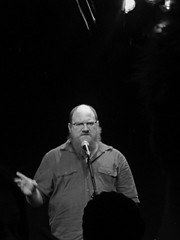
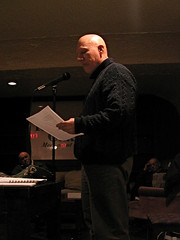
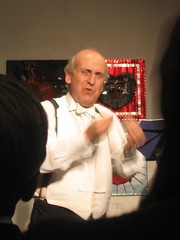
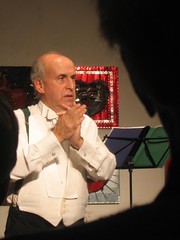
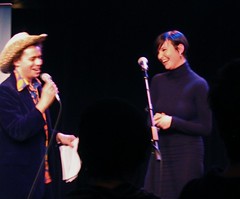
The CBC Poetry Faceoff was Feb 25 in Ottawa. The show will be aired on Bandwidth on Saturday but a full room at 4th stage NAC got to see the poetry competition live with Alan Neal hosting in his famous velvet suit, this year topped up with CBC's answer to the Hawaiian shirt. Here he is with a representative from Sage Youth, the literacy group that door proceeds went to. They offer free tutoring for youth at risk, ages 5-18, in homeless shelters and community centers. Their clientele are kids in challenging circumstances, such as new immigrants and kids with learning disabilities. They offer a low tutor student ratio.

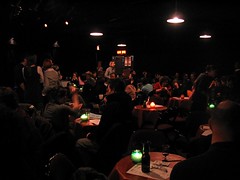
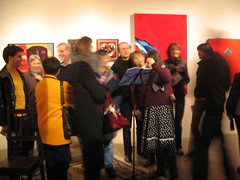
There was a decent-sized crowd. This photo from intermission catches about 1/3 of the enthusiastic room. People were asked to do the drumroll on the table since the drumroll was cut due to CBC cutbacks. ;)

There were swag bags of CBC merch for questions on lyrics about heat and trivia questions such as who is Canada's Poet Laureate a) George Bowering, b) Dennis Lee, c) John Steffler or d) Margaret Atwood.

Which children's show was bpNichol a writer? a) Sesame Street b) the Muppet Show or c) Fraggle Rock.

There was also practice cheering and snare drum effects.

crowd at intermission

At halftime, while votes were counted, Oni gave a quick update on her poetry travels.

Oni Rusty
Rusty performed a poem on Icarus, the real story and how Daedalus reported it wrong. His feathers did melt off, each feather a poem taken too high, and he did fall, but he didn't die. He fell onto the backs of other people who fly, who saved him from falling all the way, with their own feathers supported him to fly another day. With community.

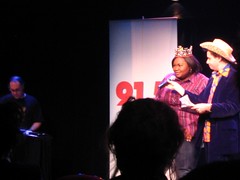
The outgoing Queen
The turning over of the crown from last year's reigning Queen, Q the Romantic Revolutionary.

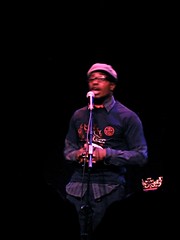
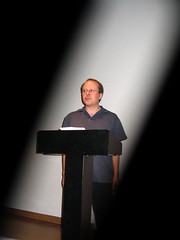
The poets to represent Ottawa are more of a team themselves than competitors. Those who were vying to go to the provincial level competition were to be: Danielle K.L. Grégoire, Free Will, Stachen Frederick, Michelle Wardman and Ian Keteku, a.k.a. Emcee E. Frederick became ill the morning of the competition so CBC producers called on Capital Slam poet Nathanael Larochette to fill-in.

While the other 4 got their prompt 2 weeks in advance, Larochette had to compose and perform for broadcast a poem on the subject of "heat" within 12 hours. He was up for it, although he said when he got the call, had he been awake, he might have thought twice. But in life there is just doing your best.

Each poet had quite a different take on heat.

Free Will Free Will interpreted it as turning up the heat to make a political revolution by 2010. "One revolutionary gone is not a revolution dead". He incited change of the corrupted systemic oppression of natives by whites and to overturn government "scum" who should roast in hell. The 18-year old has a new CD for sale of his slam poetry. Last year he won the spoken word competition and represented Ottawa at the National Festival of the Spoken Word 2007 in Halifax.

Emcee E

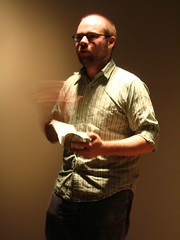
Ian Keteku, a.k.a. Emcee E twisted the tone in the room 180 degrees. He's a journalist and the founder of the Hip Hop Initiative which seeks to destroy preconceived notions about hip-hop culture and show how spoken word is a tradition of oral culture not urban decay. He was a semi-finalist for the past three years on Canada’s Next Great Prime Minister completion

He opened his time at the mic by saying: "I don't have a poem. I have a problem. I just got laid off of my job as dragon slayer." He went thru how hard it is to find damsels to save this days, women being so self-reliant and dragons so rare. He spun in a little politics and some comic twists of relationships of falling into a slow moment into someone else's pure beauty where she "pierces the heart/ like a good book/ like the English patient" (which got ripples of laughs) "but no time for this I'm freezing my ass off". When he did find a dragon, they roasted marshmallows and just chilled together. He recommended him some cream for those dry scales.

Michelle Wardman
Michelle Wardman (seen here pre-formance as trying to extract herself from saying she is a tree hugger, literally). Asked what kind of trees she likes to hug she said "I like the big ones." Blushing madly she tried to correct herself saying she knows the theme is hot but she didn't mean it like that. She likes old ones. Neal then said, and we're not going to get it any safer for radio from here. Next question.

When performing she opened up by singing and her take on heat was the crazy cotton candy throbbing member love where you don't even care anymore if the poem you write is any good or not. She got a rousing cheer from the audience for her piece too.

Danielle K.L. Grégoire
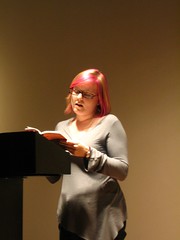
Danielle Grégoire took her cue of "heat" to be literal, global warming and homelessness in -40 degrees before windchill where you skin freezes in under a minute and why don't we care about the people right here any more than the pigeons. When we think globally do we forget what is right here. Don't get me wrong I'm not saying we should pollute but a few degrees warmer on the streets where people sleep...And she related the story of Ben, a street artist who asked for a blanket, and would it be too much to ask, for a pillow too. And his eye pop when she actually came back with them and gave him them. She talked about resilience of species and how they adapt, how monkeys stranded on a Mexican island became diving monkeys to survive until they became a tourist attraction, and obese beggars but ate fruit that kept their diabetes in check. And if global warming happens, animals will adapt, people will adapt, because there is resiliency.

Nathanael Larochette
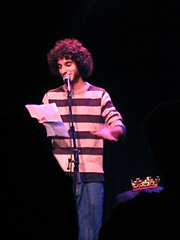
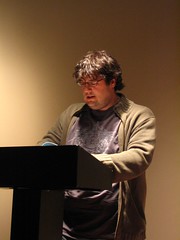
Nathanael Larochette, the late entrant took the idea of heat as heat as hate. One person who "sets afire everything in her path" when the "only heat in her life is hate." The poem took us on a magic ride (when with a single clap the audience opted in on the ride) to see the ripple effect of anger and our interconnectedness, how person to person, short fuses are transmitted. Giving a finger in traffic make someone else curse at a clerk, makes someone short with their kid, makes them nervous and distracted and walking into traffic among drivers preoccupied, caught in keeping alive their anger of argument from the night before. It was concrete and illustrative as Grégoire's. Could have heard a pin drop as he read and when he won, he got a standing ovation.

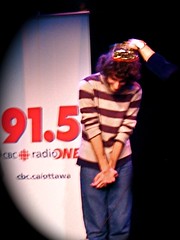
Nathanael Larochette
The crowning of the new king for 2008. His poem will be on the CD anthology of the best from each Canadian city competing.

Friday, February 15, 2008

Ian Roy at Tree

Ian Roy
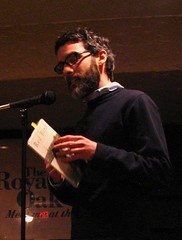
Ian Roy was the feature reader on Feb 12 at the Tree reading series. He read from Red Bird. (Good title. Mary Oliver will be snatching it in April.)

Ian Roy He segued from that book of poems to People Leaving from a lilypad hop poem to poem by some commonality (such as a house in Quebec). A snippet of poem? unfailingly, another failure and I swerved to the ditch to wait for morning light to begin, because I always think better by morning light.

The story he read was about a wedding party waiting for the bride to arrive. It was inspired by listening to the song $1000 Wedding. You can read a different story out of the collection here.

The open mic had a few people at it. I didn't get photos of everyone.

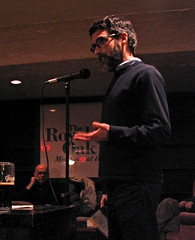
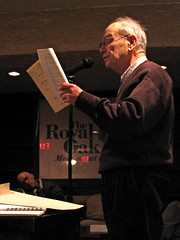
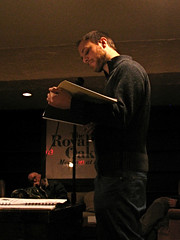
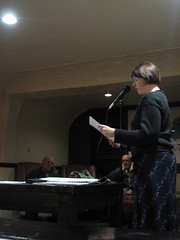
Murray
Murray Citron reading a Munger sonnet translated from Yiddish on birds and one of his own pieces contemplating family, what kids expect of parents and on a cowbird. The eggs are placed in the another nest to be raised by any number of species of birds, fed by yellow or blue wings where baby cowbird learns instinct sometimes lies. Murray read at Sasquatch as well.

Josh Josh Massey was reading from Historic song from Puddle Leaflet #21 a mardi gras poem of the king clothes in rags and the scullery queen/to usher thru revelry a new solar calm". Max read his Cottage Sestina which would really lose its effect to excerpt in part.

Pearl
Pearl Pirie read a couple poems including a first run thru of train and bus west of Oujda the bus stopped in the middle/nothing in any direction//by nothing how often do I mean/ no building, no tree, no person/ no government printed sign.

Sean
Sean Dowd read poems of meeting someone from years before and deciding we can talk live as neighbours/overcoming/basic wage and divergent paths.

Max pointed out in announcement that The AB Series is this Friday the 15th and will have Jay MillAR, Monty Reid and Emily Falvey.

Tuesday, February 05, 2008

Basement Tapes Review Now Live at Matrix Magazine Site


Dear Ottawa Poetry Aficionados,
For those of you who missed my review of Basement Tapes by Marcus McCann, Andrew Faulkner and Nick Lea, in Montreal mag Matrix, the article is now available for free online. The collaborative chapbook is published by McCann's press The Onion Union, and has recently gone into its second edition.

Friday, January 25, 2008

Writers Fest Survey

If you haven't filled it out yet, there's still time...

We're developing a strategic plan to help us continue to grow the Festivals - and we're hoping for as much input from the public as possible, so we would appreciate your feedback and input through a short confidential survey. You can find it here.

If our appreciation isn’t enough incentive, how about a Festival Pass for the Fall 2008 Edition, plus a $25 gift certificate from Nicholas Hoare books?

After completing the survey you can leave your name and contact details if you would like to enter a draw for this prize package. The survey will close at 5pm January 31st and the winner of the prize draw will be contacted on February 1st.

Friday, January 18, 2008

Bywords Warms the Night V


Bywords Warms the Night V
Sunday, January 20, 2008, 2pm
Chapters, 47 Rideau Street
Launch of the winter Bywords Quarterly Journal with readings by Jim Davies, Jeff Fry, Joseph Kuchar, M.A. Lithgow and Catherine MacDonald-Zytveld and the music of Glenn Nuotio.

Food Drive for the Ottawa Food Bank, in association with Eggspectations. Donations of
non perishable food items are welcome. Drop them off at Eggspectations, 171 Bank Street or bring them to our reading.
Contact Info: Amanda Earl: tel. 613 868 1364 and e-mail: editor@bywords.ca
Amanda Earl
Managing Editor
http://www.bywords.ca/
PO Box 937
Station B
Ottawa,On
K1P 5P9
Tel. 613 868 1364

Wednesday, January 09, 2008

NEW YEAR SPOKEN WORD CHECK-IN

2008 looks very good from this end. Here are a few of the things I'm looking forward to in the next month, not so much in order of significance as of chronology:

ARTISTIKA

January 11, Artistika takes place. This is to say a benefit show at Babylon, featuring the Oneness collective, whose birth late last year could be witnessed at Free Will's CD release in December. The emerging collective is a loose and fluid joint project including One, Free Will, Nathanaël Larochette and others in permutations divers and configurations fresh of music and text. But that's just my ambiguous descriptive stab at it. For a sharper idea, witness them yourself! It's a fundraiser for the Mayan Alternative, and features other multi-disciplinary performances.

ANOTHER FRIENDLY OPEN MIC!

There's a new open-mic at the Laff Tuesday nights. Knowing organizers/cohosts Tiah Ase and John Carrol, expect it to be warm and full of surprises, and a nice place to fire-harden your verbal palisades. Or balustrades. Or what have you. Situated in the Chateau Laffayette, you know it will be full of brilliant minds and experimental work, along with the hardcore cast of Akse/Carroll invitees. Familial conviviality and quart bottles all around! Show up anytime after 8, I'm told.

ALMONTE!

Danielle Gregoire, as usual, is up to something. It's called the Spoken Word Plot, and it's launched at the Ironworks Pub in Almonte on January 29. How can anyone resist? The first program includes a too-rare performance by local slam veteran Matt Peake, and debut performances by participants in Danielle's currently-running spoken word performance workshop! If you want to get in on Danielle's three-week February workshop, please email Danielle.

PHOTOS AND TEXT

Poetic Intentions this month is called Photogenic Memories, and should appeal to many local poets as strongly as it does to me. For Monday January 28's show, Tiah has asked for pieces inspired by or related to photos. If you submit the images ahead of time, she will arrange projection of your photos during the performance/reading, and all poets are asked to have hard copy of both text and photos for display at the event. Put on your multimedia caps! More info by email.

BLACK HISTORY MONTH SLAM

Capital Slam on Saturday February 2, feature Doretta Charles, is presented in partnership with STAND (students taking action now on Darfur). The show raises funds for STAND's work, and will be graced by Doretta's first feature set in quite a while, which many of us have been greatly looking forward to. It's always good to see people in the slam who haven't done so before, too! (hint hint why dontcha it's fun)

OUT OF TOWN AND NOTABLE

Throw Slam in Montreal featuring Common Unity collective: Jan 29 [info on "the Facebook"]

Story Slam in Toronto: Jan 12 [info on FB]
$100 Slam in Toronto: Jan 27 [info on FB]

One other mention: watch out for a [tentatively untitled, if that makes sense] performance poetry tour through Ontario and Montreal in April, as we observe National Poetry month. Details will materialize incrementally, as is their way.

Monday, January 07, 2008

What are you currently working on?

a roundup of mostly poetry updates by Ottawa's poets.

Mike Blouin (I’m Not Going to Lie to You, Pedlar Press, 2007)

Currently I am starting on the edits for the novel for Coach House which is due out in September ( I actually really enjoy the collaboration of working with great editors ) as well as completing a poetry manuscript tracing the intersecting lives of American icon Johnny Cash and Canadian poet Alden Nolwan. I'm also finishing a second novel as well as preparing to teach some poetry and some Hamlet.

Daniel Boland (Toward the Chrysalis, Stone Flower Press, 2005)

I'm steadily working away on my writing (when I can find the time). I have more or less completed a second poetry manuscript entitled "Chasing the Hermit" (though I'm still revising it a bit) and I have a third newer collection of poems in the works as well.

Two of my poems were recently named as runners-up for the Arborealis poetry prize, and I'm trying to keep a few individual pieces floating around. That's about it.

Stephen Brockwell (The Read Made Up, ECW Press, 2007)

refining the Pumping Irony poetry workshop.
- investigating the nature of the love poem as an embodied utterance ... lots of lineation experiments there.
- skulking around trying to find a theme for the next project. "Excerpts from 21 Impossible Books" is at least a starting point.
- interviewing John Pass about poetry and emotion.

Ronnie R. Brown (Night Echoes, Black Moss Press, 2006)

One of my first writing-related goals for the new year is to (finally) edit, and organize into a full manuscript, the poems from my "fairy tale" series. The middle section of this collection, "Songs of Eve" need editing and up-dating and the poems in the other two sections need to be ordered
and, in some cases, tweaked. This is something I've been putting off for far too long, and so it's now or never (I guess). I would really like this ms. to be ready to submit before '09 looms.

As well, I plan to keep writing poems to complete the manuscript (tentatively) entitled, ROCKING ON THE EDGE. Many of these pieces are on dark topics (post partum depression, abuse, murder) but I want to add some balance to the collection (which is needed literally and figuratively when you're working "on the edge, " I guess) with more humourous pieces
(I already have poems on aging rockers and shoes.) Strange to say, but "funny" is harder to write these days than death and destruction. Guess that revelation might be scary if I decided to analyze it, but I don't think I'm going there any time soon!

Cyril Dabydeen (Drums of My Flesh, Tsar Publications, 2005)

I am currently working on a new book to be called UNANIMOUS NIGHT (a take-off from the Argentine writer Borges), which perhaps reflects some of my diverse South American, Caribbean and Canadian experiences. I was a guest of the Netherlands Association of Canadian Studies last year (2007) and found a lot of people asking me questions, being curious no doubt, about my "hybrid"--meaning diverse--background and how this influences my work. A
Spanish professor of literature did a paper on my work at a conference at Cambrigde University via the British Assoc. of Canadian Studies, and raised similar questions.

Rhonda Douglas (Time If It Exists, The Cassandra Poems, above/ground press, 2007)

At it happens I'm currently working on the edits for my book out with Signature next fall, the new title of which is "Some Days I Think I Know Things: The Cassandra Poems."

Other than that, I am working on a short fiction collection and have about half of a second poetry collection in the works as well. In theory I am writing a "novel" for my class in the UBC MFA program, but this is more theory than practice at the moment.

Anita Lahey (Out to Dry in Cape Breton, Vehicule Press, Signal Editions, 2006)

I'm working on a few sets of poems, one relating to kickboxing, one on men, and one on obsessive reading. I am also working on a draft of a nonfiction manuscript, an expansion of an article I wrote last year for Maisonneuve about a friend who died young of cancer. The article was called "How to Be Friends with a Redhead."

Anne Le Dressay (Old Winter, Chaudiere Books, 2007)

I tend to work on individual poems rather than on focussed projects, but I'm still writing regularly. You can say I'm in the first stages of putting together a new collection.

Seymour Mayne (September Rain, Mosaic Press, 2005)

I am finetuning a further collection of my own word sonnets, some humourous, some meditative.

During the winter I will be launching a new book, A Dream of Birds:
Word Sonnets (Allied Widget) which I have co-authored with the Montreal poet and novelist, B. Glen Rotchin. We will be reading together at TREE on March 25.

In the meantime, translations of my selected poems are scheduled to appear in French, Hebrew, and Spanish editions in the coming year.

In the pipeline as well is Pluriel, a bilingual anthology I have co- edited, highlighting the diversity of recent Canadian poetry. It is scheduled to be published by the University of Ottawa Press in time for the celebration of World Poetry Day.

Nadine McInnis (Two Hemispheres, Brick Books, 2007)

I'm working on a collection of short fiction, almost finished, called Where All The Ladders Start. I never know how to describe stories thematically so I'll just say that I'm interested in fiction with language as lush as poetry, with vivid images, exploring the place where the conscious and unconscious meet.

rob mclennan (The Ottawa City Project, Chaudiere Books, 2007)

my poetry projects (as of January 3, 2008):

I've got numerous fiction, non-fiction and editorial projects currently on the go. Right now, I've got about half a dozen completed poetry manuscripts that are looking for homes, and another few that probably need some kind of finishing moves. Since I've been in Alberta, I've started a poetry manuscript called "wild horses," including a whole
bunch of smaller sections, poems, sequences and such, including a sequence called "map of edmonton."

My version of George Bowering's "Curious," the book "apertures," is at roughly eighty pieces, so would like to get another forty finished before potentially pulling out about a dozen or two to make it publishable. I've got another manuscript of essays on Canadian poets and poetry, and have been working on dozens of reviews and essays and interviews, including on the poetries of Anne Carson, Stephen Brockwell, David McGimpsey, ryan
fitzpatrick, Monty Reid and Sandra Ridley.

There's a four hundred page poetry manuscript called "a day book" that I need to re-enter and organize in some kind of coherent way; should I break it down into four equal-sized parts? Should I try to make it into a single manuscript? Should I just leave it where it is, hiding out in my computer?

There is a chapbook-sized manuscript of collaborations with the American poet Lea Graham that have been sitting around for some time; a few will be appearing this spring in The Capilano Review, so at least they're getting out into the world. What I'd really like is to be able to sit down with Lea a few more times and hammer it out into a book-length manuscript, but god knows how long that might take.

There are also some other projects I've started and haven't had the proper time to dip back into, including the long poems "Instruction Manual," "bank street: a somerset psalter" and "After Spicer" that could be anywhere from chapbook to book length once they're finished, if I can re-enter them with the time and attention I think they need.

That's all I can think of, for right now.

Susan McMaster (Until the Light Bends, Black Moss Press, 2004)

I'm currently working on three separate manuscripts. The first is a narrative/historical poem sequence around the bitter and unusual strike at the National Gallery in 2001, which incidentally and oddly coincided with my millennial "Convergence: Poems for Peace" project (that brought poetry and art from across Canada to all Parliamentarians), September 11, 200. The tension between my generalized, idealistic, and Quaker-based promotion of peace-making and negotiation in Convergence, the sorrow and shock of Sept 11, and the failure of negotiation and the intense and personal strains and angers I felt as I walked the lines during the strike together make a potent mixture I am still trying to sort out these many years later. I may not publish this ms. for a few years more -- until it is in some way an integrated whole.

My second manuscript is a series I am writing on the decline of my mother, whom I love and respect very much, into Alzheimer's. This is a common, sad story, with un-looked-for bravery and occasional joy, among continuing grief. I started these poems 2 years ago, and will complete them at a yet unknown moment. I've been reading from the poems, and publishing a few, but don't want to rush them; the topic, and my dear mother (all our mothers), are too important.

So neither of these books may be published soon. In the meantime, I am having an interesting time assembling a "Selected and New, due as of current plans to be published by Black Moss in 2009. Most of my books are out of print (one is, amazingly, selling for $187 on Amazon.com!). I'd like the poems to be available, and I'd also like the chance to revise them -- which in most cases means Cut! Cut! Cut!, as Miriam Waddington once told me pointedly years ago. This journey back, and in a sense forward, is invigorating, and reassuring. I did write a poem or two I still like...

I also have a couple of related projects underway. One is to produce a similar "selected" for my music-and-poetry work from the 1980s to now. Musician and producer James Stephens (Stove Studios, Chelsea) and musician and collaborator Alrick Huebener have been helping me on that. James recently mastered a re-issue of my 1980s First Draft tape "Wordmusic", with a few contemporary works taped by Alrick and including poets Max Middle, Colin Morton, and Penn Kemp, and musicians Huebener, Linsey Wellman, Jamie Gullikson, Rory Magill, David Broscoe, and Jennifer Giles. There is also some new recording I hope to do with these and other musicians, especially Mike Essoudry and Mark Molnar, for possible inclusion. A long-term project, possibly out next year if I can find funding.

And, last (for the moment), I'm beginning a Second Draft (following First Draft, described in The Gargoyle's Left Ear) -- a regular meeting of creative people to talk about what they're doing. Who knows what might come of this? I like open-ended, collaborative ventures.

Beyond that, I'm presenting a paper and doing a reading (poems to appear in an anthology) at the Bronwen Wallace conference at Queen's University in Kingston in March, on the topic of the series of letters I edited for publication between her and Erin Mouré just before Bron died, on the subject of feminism and poetics. I'm also expecting to be doing more with John Abbott College, where I gave a "Waging Peace" reading and presentation this fall. I have a tentative project about to begin with artist Jane Burnstein. And finally, I have begun archiving my papers and electronic and visual files with the City of Ottawa Archives, which have established a Literary Heritage collection as a result of the initiative of Steven Artelle's Ottawa Literary Heritage Society.

I'll be reading from The Gargoyle's Left Ear during National Poetry Month on 10 April at the Sunnyside Public Library (Ottawa South), as part of the Canal Mug series, along with some new poems.

Colin Morton (the Cabbage of Paradise, Seraphim Editions, 2007)

I'm preparing for the press a poetry book called _The Local Cluster_, which contains mostly Ottawa poems and will be published in the spring by Pecan Grove Press of San Antonio. Meanwhile I'm working on another long poetry series, based on a historical subject and set along the 49th parallel; working title, _Boundary Issues_.

David O’Meara (The Vicinity, Brick Books, 2003)

I just sent my new book to my editor for once last look-see, and then it's off to the press. It's a book of poems that might be called "Noble Gas, Penny Black," and is due for publication Fall 2008 with Brick Books. I've also just written a stage-play called "Disaster," which is currently scheduled to be produced in April (location still pending).

Oni the Haitian Sensation (Ghettoscracy, McGilligan Books, 2006)

I just found out that "Oni la Sensation Haitienne" was shortlisted for the Montreal Arts Film Festival. The media launch for that event will be held in Toronto on Jan 22. "Oni la Sensation Haitienne" will play on TV Ontario, perhaps on other television networks and will be featured internationally as part of this festival.

On Jan 16th, I'm performing at City Hall and on Parliament for Martin Luther King Day. In Mid Jan, I'm performing for CUPE. I did an interview for Macleans magazine, which should come out soon. In February I'm off to Whistler to work with the Olympic Writers Circle- then I go to Montreal to perform in an erotic poetry showcase called The Art of Aural Sex, then I perform at Winterlude. I was invited to do a launch of Ghettostocracy on Parliament Hill in February.

Monty Reid (Disappointment Island, Chaudiere Books, 2007)

Lost in the Owl Woods (BookThug) is just out
The Luskville Reductions (Brick) comes out in May
Forty Fucks (also BookThug) will come out later in the year

I'm working on Host (the parasitical work) and The Grand Zoo (loose translations from the Cuban poet, Nicolas Guillen) and struggling with translations of contemporary francophone poetry. Plus writing songs and playing as much music as possible with friends.

Sandra Ridley (recent work in Arc, Carousel, Grain, stonestone and Taddle Creek)

This winter, if all goes as planned, I will finish my first manuscript of poetry (Downwinders), which is structured to form a loose narrative about a prairie family living downwind of Cold War nuclear testing. Part imagination, part fact. In tandem with this project is the production of a hand-bound chapbook of poetry (Lift) with Saskatoon-based publisher JackPine Press. (www.jackpinepress.com) With a June 2008 launch date, this chapbook will be a collaboration with my artist spouse Eric Slankis and will contain original linocut prints and twelve ghazals taken from the larger manuscript.

Aside from that, I am up to my ankles in research and tentative first drafts of poems for a second manuscript, which strangely, or perhaps not too strangely, has quickly become much more interesting to me than the first.

Rob Winger (Muybridge’s Horse, Nightwood Editions, 2007)

I'm working on a new ms that takes on the idea of a poetic miscellany, trying to write on/about/with/past all of the most cliched topics that most often appear in such collections.

~~~~
much thanks to all of you who responded. perhaps we'll make this an annual feature.
Friday, January 04, 2008

pictures from the peter f yacht club #8 ottawa launch

Here are some pictures from the reading we had on December 22, 2007 at The Carleton Tavern [check out John W. MacDonald photos of previous Tavern readings/shindigs here and here] to celebrate the eighth issue of The Peter F. Yacht Club. It was a combined reading/Christmas party, and all-around general excuse to hang around and get silly. It was also a good excuse for a number of us to be able to hear each other read, which might not happen as often as some of us would like; being just before Christmas, the crowd wasn't large, but it was big enough, and certainly appreciative. Readers included Amanda Earl [see her write-up on such here; read her 12 or 20 questions here], Roland Prevost (the pictures here were all taken by his lovely wife, Janice Tokar), myself, Sandra Ridley [see my note on her here] and Nicholas Lea (recently returned to Ottawa from Fredericton; he read a poem responding to one by American poet John Ashbery); we even had Pearl Pirie read as well, even though she's not in the issue, but she's been doing such interesting work lately (she read from a poetry manuscript she's been deep inside of for the past few weeks). Even our bartendress, Kelli, jumped into the fray. There are even some photos Pearl posted later, on flickr: here and here and here and here and here and here.

rob mclennan;
Roland Prevost;
Pearl Pirie;
James Moran, bartendress Kelli + rob mclennan;
Nicholas Lea;

An appreciative crowd, some of the audience included Steve and Cathy from Dusty Owl, James Moran and a very pregnant Anita Dolman (she declined our invitation to read), Charles Earl [see the photo he took of Ridley and I here], John W. MacDonald, Monique Desnoyers, Rachel Zavitz, Carmel Purkis and Michael Miller; it was too bad we couldn't get some of our other regulars out, such as Jennifer Mulligan, Monty Reid, Stephen Brockwell, Marcus McCann, Jesse Ferguson, Clare Latremouille or Max Middle. Currently, Jesse Ferguson is putting together the next issue for February, and another "Edmonton issue" is scheduled for the end of spring. Can anyone say "further launch"?

Saturday, December 01, 2007

mother tongue books OPEN HOUSE and BIRTHDAY PARTY

mother tongue books OPEN HOUSE and BIRTHDAY PARTY,
TEMBO * FUNDRAISER and,
Celebration of Ottawa women poets; Passed and Present.

Sunday, 2nd December, 2007: 2:00 p.m. ‘Til 6:00 p.m.

There will be short readings throughout the day; A Silent Auction; 50/50 draws every hour; a raffle and, lots of in-between time for shmoozing, celebrating, remembering poets ‘Passed’ and wishing mtb “a very HAPPY 13th BIRTHDAY” and anything else that looks like fun for a passel of poets to be doing while we raise money for mother tongue Scholarships to send young African women to High School in Tanzania.

JC Sulzenko has agreed to start our celebrations off at 2:30 p.m.; reading SYLVIA PLATH and some of her own work. (JC has also agreed to sign copies of her own childrens’ book, “Boot Crazy”).

Below is a tentative list of readers;
SYLVIA PLATH, JC Sulzenko;
JANE JORDAN, Sylvia Adams;
PAT LOWTHER, Barbara Myers;
DIANA BREBNER, Mary Trafford & LM Rochefort;
MARUEEN GLAUDE, Louise Mcdiarmid & Lois A. Wraight;
MARIANNE BLUGER, Ronnie R. Brown;
RUBY SPRIGGS, Michelle Desbarats & Laura Rayner;
CANDIS GRAHAM, Diana R. Windle;
ENID RUTLAND, Susan McMaster & Maureen Korp;
ELIZABETH SMART, Frances Boyle;

If anyone else would like to participate (this IS an all afternoon party): we welcome more readers; donations of cheese, crackers, cookies, wine, etc.; good used books for re-sale or items for our silent auction will also be appreciated. (among our Silent Auction Items; Project TEMBO African artifacts, we have a small PATRICIA KIRBY watercolour and, The Table Vegetarian Restaurant has given us $100 in Gift Certificates). We are still looking for some high-end item(s) for raffles.

In a village world where $720 will send a young woman to High School for 4 years, $1500 will train a school teacher. $150 will help establish a business and, a mere $10 will buy a chicken - every dollar raised will be put to good use. And, not to be crass, we will accept cash

If you have any ideas, donations, questions or, if you would like to schedule yourself to read; call mtb: 613+730-2346 or Lois: 613+722-6759

Sunday, November 25, 2007

Merz

Kurt Schwitters collected fragments of discarded objects, the first almost a century ago, some made into make what we'd call installation art projects today. He also assembled sound and language fragments – coughs, sneezes, stutters, syllables – into poetry.

Froehlich as Schwitters Froehlich as Schwitters Froehlich as Schwitters
Peter Froehlich's one-man-show is a collage of MERZ poems meshed into a context of the anecdotes and legends of this artist. The show ended at Nov 16 at the Cube Gallery

The first part of the show was biographical, a history lesson done in broad black comedy style of grief and repurposing props even so the fishbowl, the watery grave of his beautiful loyal fish, become water to nonchalantly drink, then later the glass becomes wine at the cafe table at a banquet of Hitler. What we think is a coughing fit from drinking the water and him groping forward to the music stand for support, is transformed to him tuning to the next page of notes and that the coughing is sound controlled. Everything expected is turned on its head.

The play with reversals became a subject almost as much as any subject, such as beautiful Anna, "the same from the front as from the back" (A-n-n-a, or a-n-n-A). Anna is so unlike Hannover itself, which in false etymology becomes the forward of what it is in reverse "re von nah" re –back, von – from, nah– near. Therefore it reads and means forwards Hannover – "forward to far". His stepping out into the meta was explicitly explained as well. "I play off sense against nonsense. I prefer nonsense but it doesn't matter. It's a matter of taste."

Timing, pause, variance in rate and tone of voice independant from meaningful words all had an perceptible reality in teased out in isolation. Imposing meaning or letting sound become meaning or meaning disperse from conventional meaning is the core of Metz. It deals with the same sort of reducing sound until it loses meaning and starts to mean again rose occasionally in his syllables as The Four Horseman Project.

How to express the sounds to text is a bit tricky. The whole show is poorly captured in piece or page, being so auditory and interwoven. Does it give any idea of the play with sound expectations of lo la, la lo, lo, la, la lo...da da, da da, and the French alphabet letters in paired sets so that BéDe, BéC BéBé Béah. The refrains of building sound made a sort of narrative arc of coming to expect a pattern of vowels to repeat. They became like chapters of certain vowels, then a page turn and a new set.

He was playing with the expectations of linear narrative of relating a story, losing his place, becoming confused, and starting way back in the story, tangenting, where was I? oh yes and restarting way back in the story again. The audience laughed harder each time yet each time he told it, he pivoted the focus. When he got most of the way thru the story of the crowd gathering to look at a "man who was just standing there", he wrote out one character but left in the discontinuity, saying, this is where the police came for him, except that can't happen now because he no longer exists.

This looped back in the second half when the music stand of pages he was conducting himself from diligently progressing forward for half the notes, he started messing with direction, going backwards thru pages instead of forward or flipping to (seemingly?) random pages forward and back thru the score. This made peals of laughter and started the couple people on their giggle fits again.

An Ottawa Citizen report by Patrick Langston. No one left as Langston related for the performance he saw, but people did ragdoll over with laughter, 4 people in rows ahead were wiping tears from their eyes laughing. The head bobbling he remarked on of people moving in rhythm thru the sounds was there too. Which isn't to say it was non-stop comedy. The build of tension, the play of Nazi movements against the life of the artist were there, the neutral palette of sounds and the dramatic stories against the deliberate tossed in nonsense all kept the tone alive.

IMG_1772
As soon as the performance ended a portion of the crowd rushed the stage to get a personal look at those notes that scored the sound. How did he do that. People were flipping thru and peering over and around each other.

You can hear the original recording of Schwitters doing Ursonate at UBU. In the original, he was more playing with notes and musicality it seems. This interpretation used more monotone with sudden leaps up the scale as yelps that broke the pattern in what seemed like falsetto by comparison. You can hear another version of the script at Ubu by Jaap Blonk.

Thursday, November 15, 2007

12 or 20 questions: with Amanda Earl

Amanda Earl’s poetry will appear in upcoming issues of Rampike and the New Chief Tongue Review. Her second chapbook, Eleanor was released this summer by above/ground press. Her poems have appeared most recently in www.ditchpoetry.com, Holy Beep, launched during Calgary’s bpNichol benefit show with jwcurry, www.listenlight.com, the Ottawa Arts Review and http://www.ottawater.com/.

Her visual poetry has appeared in the Peter F. Yacht Club, http://www.logalia.com/ and Unlikelystories.org. Her work also appears in the gallery at http://www.vispoets.com/.

Amanda is the managing editor of the Ottawa-based literary site, http://www.bywords.ca/ and the Bywords Quarterly Journal, a journal for poetry by writers with an Ottawa connection.

Amanda also writes fiction. Her stories appear most recently in Lies with Occasional Truth (http://www.lwot.net/), Front&Centre Magazine (Black Bile Press), The Puritan and various anthologies published by Alyson Books, Cleis Press, Thunder’s Mouth Press, and Carroll and Graf.

When she blogs, she blogs:


1 - How did your first chapbook change your life?

that was Blood Orange (Friday Circle, 2003); it made me afraid of seeing my words in print because right away i wanted to change some things. i hadn't had much poetry published. it also made me want to get more stuff published and inspired me to want to publish chapbooks. i was weirded out when people asked me to sign it. i felt like an imposter. this still happens.

2 - How long have you lived in Ottawa, and how does geography, if at all, impact on your writing? Does race or gender make any impact on your work?

i've lived in Ottawa for 20 or 21 years depending on whether you use the new math or the old. geography and place inspire my writing. i wrote a poem series called "November" last year that was set in various parts of downtown Ottawa; it was just me walking around and treating myself to an exquisite lunch complete with beer or wine. even my second chapbook, Eleanor (above/ground press, 2007), about Eleanor of Aquitaine, who lived in France and England in the Middle Ages, manages to have bits of Ottawa in it. if i'm in different cities, the place also influences my writing.

race has no affect on my writing so far.

with gender, i'd like the voices i write to reflect whatever gender they are, including no gender if gender isn't relevant; but i want to be blank and not inflict my gender on my writing. i sometimes wish i'd chosen a gender neutral pen name instead of my own and maybe i'll do that sometime.

3 - Where does a poem usually begin for you? Are you an author of short pieces that end up combining into a larger project, or are you working on a "book" from the very beginning?

a poem begins with a moment, an image, something in freeze frame or a pique of interest about some person. for the first five years of writing poetry with any serious intent to publish, i just wrote small individual poems, but for the past two years i've been writing long poem series and i'm trying to write a book length manuscript right now. i'm on page two. this could take a while.

4 - Are public readings part of or counter to your creative process?

very much part of. i like to try out new work at open mics here in Ottawa, particularly the Tree Reading Series and the Dusty Owl. the closer i get to my time at the mic, the more i revise my work.

5 - Do you have any theoretical concerns behind your writing? What kinds of questions are you trying to answer with your work? What do you even think the current questions are?

i was happy to discover Steve McCaffery through one of your workshops, rob. in a Philly Talk between him and Lisa Robertson in 2003 and in an interview, he said that poetry was about playfulness and risk-taking. that loosened me up considerably. i've always thought, and i don't know where i got this idea, that you were supposed to aim for perfection and come at poetry from some kind of lofty place, whereas all i do is stumble and most of the time i fail to translate what's in my head into the equivalent on the page or in the air. i was very frustrated by this until i began to read poetry that played and took risks. i love the idea too that literal meaning can be sacrificed for other meanings, including the musicality of sound. that's another thing that McCaffery said.

Fred Wah has influenced my writing also; i loved what he said in side/lines: A New Canadian Poetics (Insomniac Press, 2002) somewhere that poetry is a kind of drunken tai chi, which i guess means it's a collaboration between instinct and mastery. at a certain point, you have to listen to your body: ""body's recollection, the memory behind the fingers which allows an unearthing of the estranged rhythms and improvisational potential within language." (FW from Music at the Heart of Thinking/as quoted by Rob Budde in Sidelines p. 39.)

when i read Dennis Cooley's the Bentleys (University of Alberta Press, 2006) last December, i became very excited by the line and the breath that can be part of the line. I heard Steven Ross Smith read from his fluttertongue collection at Plan 99 at the Manx Pub last year and was so excited by the way he left space in his reading, space for breath and for thinking. I just read Charles Olson's "Projective Verse" and was excited to see some similar ideas reflected there. I like the idea that a poem can have energy and that this energy can come from the line and the way the line is broken.

i'm not really trying to answer any broad theoretical questions with my work but i do get into that sometimes for individual projects. overall i'm just stumbling along and listening to what's around me and trying to turn it into something that awakens me and maybe connects with others on some level.

i do love to explore though and for particular projects i've had a theoretical concern in mind. with a chapbook i put together and self-published, 8 planets speaking in tongues (AngelHousePress, 2007), i wanted to see how sounds and invented language could work with other languages to create a specific tone or atmosphere without being necessarily comprehensible to the reader, that idea of shifting the pattern of meaning from literal meaning to sound. sometimes i like to play around with various constraints and see how that inspires my writing.

i see some polarization in poetic theory these days (probably was always there, but i'm a neophyte) with various groups dissing one another's styles or attempts and i'm not for that. i try to play with a little bit of everything. there may be narrative elements to my poetry, there may be language play going on, there may be some lyrical stuff too. i like to make use of everything in a palette and hope i don't end up with brown.

the current questions are whatever anyone wants them to be. main thing is not to stop questioning and exploring, no matter what anyone tells you.

6 - Do you find the process of working with an outside editor difficult or essential (or both)?

i haven't had much experience with that. i had fun when i was working on my first chapbook, Blood Orange with my editors. they made great suggestions and i mostly just did what they said. after the fact, there were some changes i regretted a bit, but overall, it was a better piece of writing because of their input and i learned a lot about editing. i have to be the main editor for Bywords when we publish the John Newlove Poetry Award Chapbook Series, and i find that to be a very instructive and rewarding experience. I love working with writers on their work and trying to positively affect their creativity. it's a brainstorming process. when writers get excited about their writing and my input has in some way contributed to this excitement, i feel very happy.

7 - When was the last time you ate a pear?

"a pair of what?" she asks. um....this summer, i remember it was red, and i began at the top, removing the stem and gently biting the tip, letting the juice run down my chin.

8 - What is the best piece of advice you've heard (not necessarily given to you directly)?

"The worst piece of advice ever is to write what you know. Write about what you don't know instead." (Shane Rhodes-side/lines, p. 180)

9 - How easy has it been for you to move between genres (poetry to reviews)? What do you see as the appeal?

i go from poetry to fiction to blog entries, to songs and reviews. sometimes my rhythms are right for prose and other times for poetry or other stuff. i can't write my own stuff when i'm working on a review, because i tend to want to read all of a person's published books in order to gain a deeper insight into the poetry. it takes a lot of work and energy and i tend to be focused exclusively on that when i do a review. sometimes reading a good novel will inspire me to write a poem. it's like i scratch my head and a leg lifts. i have no idea how my wires are crossed up there.

the appeal is that when i get stuck on a poem series, i can move on to a blog entry or a song or even a letter to the editor. my belief is that as long as i'm writing something every day, my creativity is still in motion.

10 - What kind of writing routine do you tend to keep, or do you even have one? How does a typical day (for you) begin?

i start at about 7:00 am and i write until about 1pm. i eat lunch and nap in the afternoons. if i'm working on a particular poetry project that requires research, like my current one, i'll spend some of the afternoon reading and researching and writing bits and pieces which i'll turn into poems in subsequent mornings.

11 - When your writing gets stalled, where do you turn or return for (for lack of a better word) inspiration?

when my words aren't coming, i go for walks, hang out with friends, make love...all that.

12 - How does your most recent book compare to your previous work? How does it feel different?

Eleanor, my recent chapbook, is four years after my first one, Blood Orange. it reflects a change in the type of poetry i've been reading; four years ago i had never even heard of Nathalie Stephens, who is my favourite writer right now, or many of the other contemporary writers i've mentioned here. the first chapbook was more imagistic and some said it was haiku-like. this one plays more with long lines and dream like states, interruptions in narrative and chronology.

13 - David W. McFadden once said that books come from books, but are there any other forms that influence your work, whether nature, music, science or visual art?

music is a huge influence on my work, as are nature, particularly weather, also food, alcohol and sex. i can't listen to music while i'm writing usually, except sometimes with fiction; i once had a character who demanded opera and sushi.

14 - What other writers or writings are important for your work, or simply your life outside of your work?

i've mentioned a few already, also you, rob mclennan, who i've learned so much from in the last two years in your workshops. others include the Surrealists like Antonin Artaud, Andre Breton, Apollinaire, Paul Eluard; playrights such as Ionesco; 19th century French novelists: Victor Hugo, Balzac, Flaubert, Stendhal; 20th Century French writers: Jean-Paul Sartre, Marguerite Duras, Albert Camus; the French Symbolism movement with Rimbaud, Baudelaire, Verlaine; Gwendolyn MacEwen, Sylvia Plath, Lisa Robertson, bpNichol, John Newlove, Nicole Brossard, Daphne Marlatt, Margaret Christakos, a. rawlings, Nathalie Stephens (her name is worth saying again because she's so fantastic). Tish and the New York School of Poetry are just starting to become an interest of mine. I have a lot to read and learn. I should really be just reading and not writing anything.

15 - What would you like to do that you haven't yet done?

i'd like to have a poetry book published; i'd like to publish someone undiscovered whose poems are exceptional; i'd like to taste something new, have a fling with a musician, have an on-going love affair with a unilingual francophone; have songs of mine recorded by someone who can play guitar and sing better than me.

16 - If you could pick any other occupation to attempt, what would it be? Or, alternately, what do you think you would have ended up doing had you not been a writer?

song writer lounge singer in a hotel lobby bar in Sarasota, Florida, working for rum.

17 - What made you write, as opposed to doing something else?

i've done a lot of other things, mostly working with French and English as a translator, revisor, editor, lexicographer, and co-owning a business, helping with the administrative and financial ends. i'm hoping i will be able to concentrate on writing for the foreseeable future.

18 - What was the last great book you read? What was the last great film?


19 - What are you currently working on?

i'm working on a series of poems about Kiki of Montparnasse who lived from 1901-1953 in France; i'm focussing particularly on the 1920s in Montparnasse where she had lovers, associated with artists and writers such as Ernest Hemingway and Jean Cocteau, posed for Man Ray and other photographers and painters. if all goes well, i would like to end up with a book length manuscript.

Wednesday, November 14, 2007

*VIDEO CAUGHT THE LITERARY STAR*

TDR (The Danforth Review) is now asking publishers, authors, publicists andvideographers to send mpegs (2-3 min clips) of author interviews, rants,vignettes, promo spots, book signings, etc. to be posted at their site in 2008 starting mid-January. So if any author fans out there in the wild worldof CanLit are screening author readings at family functions and not gettingthe response they were hoping for, please send them our way...(not your family the videos.) For specific formatting rules and regulations please emailfeatures editor Mr. Nathaniel G. Moore at features@danforthreview.com

Sunday, November 11, 2007

DC Books at Sasquatch

Sasquatch was a reading featuring DC Books authors.

DC Books, out of Quebec, was founded by Louis Dudek, and for the past several years has been led by Steve Luxton, formerly of Matrix. The press has its 20th anniversary launch at Blue Metropolis this spring.

Since I arrived partway, I missed some. I presume Peter Dubé had read from the "queer in all the best senses of the word" novel he released this fall, At the Bottom of the Sky.

Luxton read from new work, poems with a political, satirical sort of slant, which caused some appreciative chuckles around the room. He also read pieces in consideration of it being Remembrance Day such as one on Eva Braun, as well as ones from his Luna Moth and Other Poems work.

I was there in time for Newfoundlander Angela Hibbs to read from her first book of poetry, Passport. (It's got a review at TDR.)

She also did poems with a nod to Remembrance Day, being from a military family. So far as the angle she approaches from, she mentioned that in taking a workshop from Richard Harrison almost a decade ago, he advised her to not reach so deep for profoundness. She feels it is sound advice still. She says she tries to eschew phrasings in poems that wouldn't come off the tongue normally in speech but that isn't to say she is unread or making her domain the plain-speech or raw-discord or chatty poem.


Much of the book, as sampled by choices of reading, is a walking thru childhood, and teen years. For example, p. 10, Hydrology
I thought I should be allowed inside everyone's homes,
to look at their photos & clippings.
I still do. In dreams
strangers walls are upright streams.


What a fantastic image. I like her use of pause and the thought and line lengths suggesting the very unsteady river that is memory and the uneven nature of us retaining for a while, a dam breaking and much washed away and then a catching sticks in a place again.

In the series of linked poems Hydrology she contemplates a family with the trait of fear of water, how one averts the eyes from the tough veteran uncle whose soldier's hands shake at needing to bathe, using a sponge over sink for fear of water, how this thread pops up thru various people in the family, something which struck home since it runs thru a branch in my family too.

She also did some less linear literal explorations with space on the page and with dream memories such as p. 70, Vision III
music pours into the living room
alters the blank white tiles


First rule of reading: keep cash on hand to pick up books that you'd like to look thru at greater length. First rule of not putting myself in the poorhouse: don't carry cash when books are around.

Monday, November 05, 2007

12 or 20 questions: with Mark Frutkin

Mark Frutkin, an Ottawa writer, editor and journalist, has published seven books of fiction and three books of poetry. His work has appeared in Canada, the US, England, Russia, Poland, Holland, South Korea, Spain and India. In 2007, his novel, Fabrizio’s Return, won the Trillium Prize for Best Book and the Sunburst Award, and was nominated for the Commonwealth Writers’ Prize for Best Book (Canada/Caribbean region). In 1988, his novel, Atmospheres Apollinaire, was short-listed for the Governor General's Award for fiction and was also short-listed for the Trillium Award, as well as the Ottawa/Carleton Book Award.

As a journalist and critic he has written articles and reviews for The Globe & Mail, Harper's, the Ottawa Citizen, Montreal Gazette, Amazon.com/ca and other publications. His poetry and fiction have been published in numerous Canadian and foreign journals including Descant, Canadian Fiction Magazine, Prism International and many others. He has received five major writing grants from the Canada Council and numerous grants from the Ontario Arts Council.

He has also worked as a speechwriter for a Member of Parliament and for various federal ministers and has taught creative writing at all levels. He was formerly the editor of ArtAction Magazine and co-editor of ARC Magazine, a poetry journal. He has taught creative writing at the University of Ottawa, the University of New Brunswick, University of Western Ontario and Naropa Institute in Halifax.

He currently lives with his wife and son in Ottawa.

1 - How did your first book change your life?

It changed my life in the doing of it -- proof that I actually could write a book.

2 - How long have you lived in Ottawa, and how does geography, if at all, impact on your writing? Does race or gender make any impact on your work?

Race and gender, none. I've lived in the Ottawa area since 1970. To steal a phrase and book title from Guy Davenport, I'm most interested in the Geography of the Imagination. I think I could write my books just as easily from southern France or northern Italy. I don't know why I haven't...

3 - Where does a poem or piece of fiction usually begin for you? Are you an author of short pieces that end up combining into a larger project, or are you working on a "book" from the very beginning?

I've done both. The beginning is always a flash of insight and inspiration. Could be from any source: something I've read, seen, heard, etc. Sometimes, I write a series of poems on a subject that later get turned into a novel, but not always.

4 - Are public readings part of or counter to your creative process?

They aren't integral but they are part of an effort to get the word out (literally!)

5 - Do you have any theoretical concerns behind your writing? What kinds of questions are you trying to answer with your work? What do you even think the current questions are?

There are as many questions as there are writers. I don't write to a theory (I don't think many good writers do). The story is paramount. Of course, one's interests (political, social, artistic) are always interwoven with the language and the tale.

6 - Do you find the process of working with an outside editor difficult or essential (or both)?

It can be difficult. My last novel practically ruined my right shoulder from all the mouse work I had to do. But it can also be enlightening and extremely helpful, as in the case of Fabrizio's Return, which was edited by Diane Martin at Knopf, a very astute editor.

7 - After having published more than a couple of titles over the years, do you find the process of book-making harder or easier?

It's always the most intriguing mix of hard and delightful.

8 - When was the last time you ate a pear?

I've been waiting years for someone to ask me that question. I once saw a line of pears on a tree branch just above a stone wall at Monet's gardens in Giverny -- it was one of most beautiful things I've ever seen. I've always had a thing for pears -- a glass pear rests on my kitchen windowsill. Something about their suggestion of fecundity. Over the years, I guess (like many others I know), I've actually come to resemble the shape of a pear. I don't know -- a couple weeks ago maybe.

9 - What is the best piece of advice you've heard (not necessarily given to you directly)?

1) Change your attitude and relax as it is.

2) You can't always get what you want but if you try sometimes you can get what you need.

3) The love you take is equal to the love you make.

10 - How easy has it been for you to move between genres (poetry to fiction)? What do you see as the appeal?

Very easy. The appeal? Of moving between genres? Or the appeal of each genre? The appeal of poetry is that it's short. The appeal of fiction is that it's long.

11 - What kind of writing routine do you tend to keep, or do you even have one? How does a typical day (for you) begin?

No routine, although lately I tend to write a lot in the late afternoon, I don't know why. The day begins with a tumbler of bourbon and a cigar (not really!)

12 - When your writing gets stalled, where do you turn or return for (for lack of a better word) inspiration?

What's wrong with the word 'inspiration'? A lovely word, a respectable word, a word that works for a living, and so on. Language itself is always a big inspiration. I don't get stalled (knock wood).

13 - How does your most recent book compare to your previous work? How does it feel different?

My most recent book is exactly 118 pages longer than my previous work and it's on a completely different subject! It feels heavier because it has more pages.

14 - David W. McFadden once said that books come from books, but are there any other forms that influence your work, whether nature, music, science or visual art?

That's a ridiculous comment. Maybe for McFadden books come from books, but they come from lots of other places too -- people you meet, places you've been, art you've viewed, life you've experienced.

15 - What other writers or writings are important for your work, or simply your life outside of your work?

I read for work and enjoyment. Best novel I've read in the last five years: Seven Lies by James Lasdun. I love the classics (Homer, Dante, Shakespeare, Cervantes, etc. -- btw, did you know that Shakespeare and Cervantes died on the same day same year?)

Also, on my #1 bookshelf are: Joyce, Beckett, Conrad, Marquez, which basically means I've read almost everything by them.

Also, fond of Melville, Rushdie, George Steiner, Julian Barnes, William Boyd, some McEwan (just Black Dogs, really), Nabokov, Durrell, early Ondaatje, travel books, Kapuscinski, the Russians, Japanese novels, etc, etc.

In poetry: Tang and Sung Chinese poets, Japanese poetry, Apollinaire (of course), Eliot, Don McKay, some Beats, many many others.

16 - What would you like to do that you haven't yet done?

Finish the book I'm presently working on and start the next one.

17 - If you could pick any other occupation to attempt, what would it be? Or, alternately, what do you think you would have ended up doing had you not been a writer?

I'd love to paint or draw but simply cannot. I'd love to be able to play the piano but can't. I'd love to be one of those long-distance runners from Kenya (one with the wind and all that) but my legs are too short.

18 - What made you write, as opposed to doing something else?

An inner compulsion; the need for the creative to burst out like that scene in Alien.

19 - What was the last great book you read? What was the last great film?

Kapucinski's Travels with Herodotus. Film: enjoyed Avenue Montaigne; not a great film, but delightful. There are only a handful of great films and mountains of trash.

20 - What are you currently working on?

A novel set in present day Toronto, concerning a curator of Chinese art at the ROM, and also set in Sung Dynasty China (1200s).

Saturday, November 03, 2007

A B Series

November 1st the poetry and poetic prose of the NeWest tour triumvirate came to Ottawa as part of their cross-Canada reading. Last in Montreal, next in Toronto, ryan fitzpatrick, Natalie Zina Walschots, and William Neil Scott gathered a crowd in Ottawa at the Ottawa City Hall.

Max
Their readings were the launch of the newest series in town, Max Middle's A B Series.

The #2 in the series was to be held Saturday but has been postponed due to illness of the reader. The #3 reading will be queued up to November 14th's at the Avant-Garde Bar at 135 1/2 Besserer Street. It will be an Ottawa launch for Booty: Hurricane Jane and Typhoon Mary published by the Mercury Press with readings by authors Brea Burton and Jill Hartman.

The readings November 1st stocked up a variety of styles that people enjoyed even if there wasn't heckling in proper Calgary style. Perhaps call a friend?

IMG_1530
ryan fitzpatrick, previously of filling station was reading from his newest book Fake Math from Snare books with lines like 2 children are a form of pastorialism or in new poem a series of pivots remarking on our societal ADD obession with newness and change, unequal or unbalanced pairs, such as I could eat some words, or a cinnamon donut which worked some laughter out.

William Neil Scott
Neil Scott was reading from Wonderfull, which was.

Entrancing carry you away...stories such as the narrator's father riffed, the discovery of the new world by a chartered captain and the paying man who end up shipwrecked on a nameless beach at each other's throats, held at bay by an endless game of dominoes. The winner would get the peace of being the last man to use a pistol.

Natalie Zina Walschots
Natalie Zina Walschots was reading from Thumbscrews which has playful poems. What struck me most in their control of sound, reinforcing subject and mood and how sound choice moved from short i sounds and unvoiced consonants to harsher gutterals and voiced plosives. Another overview of the event is here and with excerpts of her work and more.

Some of the readers and hearers moved on to after bits including these folks.