Saturday, April 13, 2013

The Poets' Pathway Springtime Party


             INVITATION

         The Poets’ Pathway asks you 
                             to
             a Springtime Get-together

   With wine, nibblies, chat and bonhomie
          (For lo the winter is gone)    :( 

                 Between 2 and 5 pm
                    Sunday, April 14
                                        649 Brierwood Avenue   (Off Dovercourt)
                                                          
                                                    Chris, Jane and Ben  
                                                                   The Poets’ Pathway 


Sunday, April 07, 2013

Recent Reads: Jordan Abel and Abby Paige


Scientia by Jordan Abel
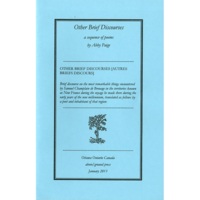
Other Brief Discourses by Abby Paige

Both titles published by above/ground press, 2013.


Last spring I attended a talk on contemporary poetry styles given by rob mclennan and Pearl Pirie. In my full account of that Ottawa Independent Writers event, I mentioned an instance when some of the group’s most vocal members took exception to the merits of visual poetry. For the purposes of that review, I referred to the incident as little more than a hiccup amidst the flow of discourse. In the heat of it, however, that hiccup persisted for over twenty minutes. Several attendees brashly refused to see substance in visual poetry while the two guest-speakers defended the form as yet another approach to language and expression.

Keep in mind: nobody had been close enough to read the text in question. The chapbook hadn’t even left the guest-speakers’ table. Nevertheless that flash example of chaotic and non-linear displays resulted in a prolonged back-and-forth, as if unearthing insecurities in the writers’ own private works. That thought-provoking debate springs to mind when I read Jordan Abel’s Scientia because, aside from the fact that I’m also a tad intimidated by visual poetry, I think naysayers would gain some insight via Abel’s sharp approach.

Scientia’s lead poem reads like a testing of organic matter, the accumulation and reductions that eventually balance in the creation of life:

“All colour terms are reduced, cut short, not the usual
length. Acephalous: without a head. Those muscid ad-
ditions that give the glandular structure that branching
apex. Abrupt or hidden. Rubbed or scraped. The third
abductor extending past the honeycomb of the op-
tic tract. The tapering surface made white like a siphon.”

As pointed and sensory as schoolbook directives, Abel’s language unfurls on the adjoining page, exploring its subject in wide-open parameters without losing the text’s core meaning. Such is the twofold approach of Scientia, a study of insect anatomy and miniscule advances that help to shape a greater understanding alongside Abel’s visual accompaniments. 

Of these eight poems fully immersed in the working gears of insect species and their visual re-interpretations (in which insect outlines blot the swarm of off-shooting words), neither approach feels the dominant one. Instead they’re co-dependent on a singular focus that succeeds in drawing the reader to parallel the base instincts of these complex creatures against our own. With particularly stunning presentation by above/ground press, Scientia’s findings can behave like Rorschach tests just as convincingly as they look the part.


Very few experiences inspire me, both as a writer and overall life-enthusiast, to the degree that discovering a new city does. Whether I’m grabbing life by the horns or trying to flee from its expectations, a new city promises that clean slate the restless crave and the committed can only dream about. Abby Paige’s Other Brief Discourses, a sequence of poems centered on a trip to Quebec, instinctively reminds me of the raw drifter muses I’d pore onto pages during countless Greyhound bus trips.

But Paige finds a unique lens beyond the escapist reverie: ‘translating’ Samuel Champlain de Brouage’s encounters in New France “during the early years of the new millennium”. In this fantasy memoir, the explorer wrestles to integrate himself amidst post-millennial Montreal’s “pox of pavement”, the outer banks of the Saint Lawrence River and citizens who illustrate modern life as secular and money-driven (compared to the late 1500s, of course). Excerpt from "VII. The metro":

“and he is gone in the earthquake of sound
that rushes past, sucking air from
the station like a succubus – and people

in the belly of the snake!  A blur of faces,
hundreds, two kissing. The doors gasp
open, we step over the threshold

and in. Inside the beast, we swim through the inside
of the earth as the dead swim, treading soil
like water, ghosts breathing without gills.”

Although fully aware he has lost four centuries, Paige’s Champlain rarely engages old-world wonderment as much as in the above excerpt. In fact many observations feel symptomatic of a far less lengthy absence; the sprouting big-box outlets in Montreal, the zoned-out travelers and junkies at the bus station. This is as much Paige’s poetic retelling as it is a fictional what-if tale and Other Brief Discourses thrives on the duality of its yearning protagonist(s).

By its very premise, this sequence of poems is charming. (A poem chronicling Champlain’s irritation while waiting at the American border keeps springing to mind.) Paige doesn’t settle for situational, fish-out-of-water commentary though, instead touching on shades of nostalgia and belonging that gather additional traction for her narrative. From cramped, urban tunnels and hostel quarters to Champlain’s soiled, waterway haunts; through the flurry of morning commuters to downtown’s late-night pub-crawls; Other Brief Discourses strikes a natural ebb and flow that frees the reader from feeling stuck in one place for too long.

Tuesday, March 05, 2013

Ottawa Public Library Poetry Workshops: Richardson, Ridley, O'Meara + Brockwell

The Ottawa Public Library is hosting four poetry workshops during the month of April to celebrate Poetry Month. All workshop are free. Register online with your public library card here: http://biblioottawalibrary.ca/en/program

Poetry Workshop with Peter Richardson
Nepean Centrepointe Library 101 Centrepointe
Saturday Apr 06, 2013 (1:30 pm - 4:30 pm )


In a supportive, small-group environment, we'll look at technical aspects of the craft as they relate to your poetry. Participants will be encouraged to provide constructive feedback. Once you've registered, submit up to four pages of poems, two weeks in advance, (as well as any questions) to peter.richardson@videotron.ca. If you don't have email, drop off your poems labelled Poetry Workshop Spring 2013 NC at the Nepean Centrepointe Library by March 22. Peter Richardson: Widely published, he is the author of three poetry collections with Vehicule Press, including Sympathy for the Couriers which won the A.M. Klein award. A fourth collection, Bit Parts for Fools, is slated for publication late this autumn or early in 2014 with Goose Lane Editions.

---------------------------------

The Poetry Garage with Sandra Ridley
Rosemount Library 18 Rosemount Ave
Saturday Apr 13, 2013 (2:00 pm - 4:00 pm )


A two-hour session on fine-tuning the mechanics and dynamics of your poems. Your work will be read and discussed in a supportive small-group environment, facilitated by Sandra Ridley (winner of the 2009 Alfred G. Bailey Prize and 2010 Saskatchewan Book Award for Publishing, a finalist for the 2011 Ottawa Book Award, and shortlisted for the 2012 Archibald Lampman and ReLit Awards). All participants will be encouraged to provide constructive feedback. Once registered, submit three poems, up to a maximum of five pages, in advance; material to be workshopped will be selected by the facilitator. Material and contact info can be emailed to sandraridley@bell.net or dropped off labelled Poetry Workshop Spring 2013 RO at the Rosemount Library by April 5th.

--------------------------------------

Poetry Workshop with David O'Meara
Carlingwood Public Library 281 Woodroffe Ave
Saturday Apr 20, 2013 (2:00 pm - 4:00 pm )


A two hour tear-down and refurbishment of your poem, this workshop will focus on structure and methods of narration. Be prepared to re-design (possibly jackhammer) your verse, discuss changes, and rebuild! Registered participants are asked to send three poems (up to five pages), two weeks in advance, to David O`Meara (dvdomeara@gmail.com) or drop them off at the Carlingwood Library labelled Poetry Workshop Spring 2013 CA by April 5th. David O'Meara is the author of three books of poetry, a play, and is the Artistic Director of VERSeFest (http://www.versefest.ca/news/), Canada's International Poetry Festival. His new collection, A Pretty Sight, will be published in fall 2013 by Coach House Press.

-----------------------------------

Poetry Workshop with Stephen Brockwell

Alta Vista Library 2516 Alta Vista Library
Saturday Apr 27, 2013 (1:00 pm - 4:00 pm )


This poetry workshop will help poets invest more verbal energy into their poems. A single poem chosen from 3 submissions (up to five pages) from each participant will be workshopped to improve musical energy with a sharp focus on voice, tone, rhythm, syntax and line. Participants will be encouraged to share their work on a free social networking website prior to the workshop. Participants will be able to comment on each other's work in an encouraging environment moderated by the workshop leader Stephen Brockwell. The initial online collaboration will set the tone for an intense but positive three hour face-to-face workshop at Alta Vista Library. Please email your poems to sbrockwell@yahoo.com, or drop them off at the Alta Vista Library labelled Poetry Workshop Spring 2013 AL by April 12th. A list of suggested readings from previous workshops will be provided for reference. Stephen Brockwell is the Author of The Real Made Up (ECW) and his book Fruitfly Geographic (ECW) won the Archibald Lampman award. An installment of the work in progress, Excerpts from Improbable Books, was recently reviewed by Mark Frutkin here: http://www.ottawapoetry.blogspot.ca/2013/01/mark-frutkin-review-of-four-chapbooks.html.

Thursday, February 28, 2013

Whatever Else: An Irving Layton Symposium | Registration Now Open

Registration is now open for “Whatever Else”: An Irving Layton Symposium, May 3-5, 2013.

You are cordially invited to attend “Whatever Else”: An Irving Layton Symposium, the 41st installment of the annual Canadian Literature Symposium hosted by the Department of English at the University of Ottawa.  This will be 3-day gathering featuring paper presentations by 17 literary critics; a film screening and director’s talk by Donald Winkler (Poet: Irving Layton Observed, NFB 1986; Red Carpet for the Sun, Diversus 2002); a round-table discussion of Layton’s life and legacy with Layton biographer Elspeth Cameron, anthologist, editor and poet Seymour Mayne, and poet-critic George Elliott Clarke; a keynote address by Canada’s premier Layton scholar, Brian Trehearne; and an evening of literary readings and performances inspired by the Layton Reloaded poetry project.

Though he was once a towering figure both nationally and internationally, scholarly interest in Layton has dwindled since the mid-1980s. The goal of the symposium is to demonstrate the continuing relevance of Layton’s contribution to Canadian literature and society by way of an examination of his work from a variety of novel perspectives.

The registration cost is $90 for academics and full-time instructors ($45 for the under-employed and retirees).  There is no charge for graduate or undergraduate students, but they must register in advance of the symposium.  Registration forms can be downloaded from the Canadian Symposium website at www.canlit-symposium.ca

For further information, please contact Robert Stacey at rstacey@uottawa.ca or Cameron Anstee at cameron.anstee@gmail.com


Registration is now open for “Whatever Else”: An Irving Layton Symposium, May 3-5, 2013.
You are cordially invited to attend “Whatever Else”: An Irving Layton Symposium, the 41st instalment of the annual Canadian Literature Symposium hosted by the Department of English at the University of Ottawa. This will be 3-day gathering featuring paper presentations by 17 literary critics; a film screening and director’s talk by Donald Winkler (Poet: Irving Layton Observed, NFB 1986; Red Carpet for the Sun, Diversus 2002); a round-table discussion of Layton’s life and legacy with Layton biographer Elspeth Cameron, anthologist, editor and poet Seymour Mayne, and poet-critic George Elliott Clarke; a keynote address by Canada’s premier Layton scholar, Brian Trehearne; and an evening of literary readings and performances inspired by the Layton Reloaded poetry project.
Once a towering figure both nationally and internationally, scholarly interest in Layton has dwindled since the mid-1980s. The goal of the symposium is to demonstrate the continuing relevance of Layton’s contribution to Canadian literature and society by way of an examination of his work from a variety of novel perspectives. The effect of the symposium will be two-fold: not only will it produce a credible and relevant body of original scholarship on the poet, it will also challenge and broaden the discourse of Canadian literary criticism by way of addressing a figure and a body of work that for almost two generations has proved resistant to the prevailing modes of critical analysis. The proceedings are balanced between papers and presentations geared towards the reappraisal of a career and those breaking new ground by reading Layton and his work in the context of questions and methodologies having emerged during the period of his neglect.
The registration cost is $90 for academics and full-time instructors ($45 for the under-employed and retirees). There is no charge for graduate or undergraduate students, but they must register in advance of the symposium. Registration forms can be downloaded from the Canadian Literature Symposium website at www.canlit-symposium.ca
For further information, please contact Robert Stacey at rstacey@uottawa.ca or Cameron Anstee at Cameron.anstee@gmail.com
We hope you can join us in May!
- See more at: http://www.canlit-symposium.ca/announcements.html#sthash.L0wEwb0s.dpuf
Registration is now open for “Whatever Else”: An Irving Layton Symposium, May 3-5, 2013.
You are cordially invited to attend “Whatever Else”: An Irving Layton Symposium, the 41st instalment of the annual Canadian Literature Symposium hosted by the Department of English at the University of Ottawa. This will be 3-day gathering featuring paper presentations by 17 literary critics; a film screening and director’s talk by Donald Winkler (Poet: Irving Layton Observed, NFB 1986; Red Carpet for the Sun, Diversus 2002); a round-table discussion of Layton’s life and legacy with Layton biographer Elspeth Cameron, anthologist, editor and poet Seymour Mayne, and poet-critic George Elliott Clarke; a keynote address by Canada’s premier Layton scholar, Brian Trehearne; and an evening of literary readings and performances inspired by the Layton Reloaded poetry project.
Once a towering figure both nationally and internationally, scholarly interest in Layton has dwindled since the mid-1980s. The goal of the symposium is to demonstrate the continuing relevance of Layton’s contribution to Canadian literature and society by way of an examination of his work from a variety of novel perspectives. The effect of the symposium will be two-fold: not only will it produce a credible and relevant body of original scholarship on the poet, it will also challenge and broaden the discourse of Canadian literary criticism by way of addressing a figure and a body of work that for almost two generations has proved resistant to the prevailing modes of critical analysis. The proceedings are balanced between papers and presentations geared towards the reappraisal of a career and those breaking new ground by reading Layton and his work in the context of questions and methodologies having emerged during the period of his neglect.
The registration cost is $90 for academics and full-time instructors ($45 for the under-employed and retirees). There is no charge for graduate or undergraduate students, but they must register in advance of the symposium. Registration forms can be downloaded from the Canadian Literature Symposium website at www.canlit-symposium.ca
For further information, please contact Robert Stacey at rstacey@uottawa.ca or Cameron Anstee at Cameron.anstee@gmail.com
We hope you can join us in May!
- See more at: http://www.canlit-symposium.ca/announcements.html#sthash.L0wEwb0s.dpuf
Registration is now open for “Whatever Else”: An Irving Layton Symposium, May 3-5, 2013.
You are cordially invited to attend “Whatever Else”: An Irving Layton Symposium, the 41st instalment of the annual Canadian Literature Symposium hosted by the Department of English at the University of Ottawa. This will be 3-day gathering featuring paper presentations by 17 literary critics; a film screening and director’s talk by Donald Winkler (Poet: Irving Layton Observed, NFB 1986; Red Carpet for the Sun, Diversus 2002); a round-table discussion of Layton’s life and legacy with Layton biographer Elspeth Cameron, anthologist, editor and poet Seymour Mayne, and poet-critic George Elliott Clarke; a keynote address by Canada’s premier Layton scholar, Brian Trehearne; and an evening of literary readings and performances inspired by the Layton Reloaded poetry project.
Once a towering figure both nationally and internationally, scholarly interest in Layton has dwindled since the mid-1980s. The goal of the symposium is to demonstrate the continuing relevance of Layton’s contribution to Canadian literature and society by way of an examination of his work from a variety of novel perspectives. The effect of the symposium will be two-fold: not only will it produce a credible and relevant body of original scholarship on the poet, it will also challenge and broaden the discourse of Canadian literary criticism by way of addressing a figure and a body of work that for almost two generations has proved resistant to the prevailing modes of critical analysis. The proceedings are balanced between papers and presentations geared towards the reappraisal of a career and those breaking new ground by reading Layton and his work in the context of questions and methodologies having emerged during the period of his neglect.
The registration cost is $90 for academics and full-time instructors ($45 for the under-employed and retirees). There is no charge for graduate or undergraduate students, but they must register in advance of the symposium. Registration forms can be downloaded from the Canadian Literature Symposium website at www.canlit-symposium.ca
For further information, please contact Robert Stacey at rstacey@uottawa.ca or Cameron Anstee at Cameron.anstee@gmail.com
We hope you can join us in May!
- See more at: http://www.canlit-symposium.ca/announcements.html#sthash.L0wEwb0s.dpuf

Wednesday, February 20, 2013

Announcing the VERSeOttawa Hall of Honour: William Hawkins and Greg Frankson

VERSeOttawa works constantly towards supporting poetry and the poetry community in Ottawa, but we are not the first to do this. There have been many important people who have helped create, shape and support this artform that we love and the community that has built up around it.

It is with this in mind that VERSeOttawa has decided to create the VERSeOttawa Hall of Honour. It is our way of recognizing the important contributions made to the Ottawa poetry community, whether through poetry itself or other methods of support (or, as is often the case, both). Each year a nomination committee will choose two worthy inductees whose work will be honoured that year, and into the future.

An induction ceremony will be conducted as part of VERSeFest. This year that will take place on March 17th.

The nomination committee this year has chosen two people to be the first inducted in to the VERSeFest Hall of Honour.

We are proud to recognize William Hawkins and Greg ‘Ritallin’ Frankson

““““““““`

As a poet, William Hawkins was nationally-known and regarded as Ottawa’s best and certainly most dangerous poet from 1964 to 1974. He published a number of books, including the infamous Ottawa Poems, published by Nelson Ball’s weed/flower. Hawkins appeared in the anthology New Wave Canada, edited by Raymond Souster as the last publication by Contact Press.

As an organizer/host, Hawkins ran Ottawa’s infamous coffeehouse Le Hibou through the 1960s with his wife. He hosted performances by Gordon Lightfoot, Leonard Cohen, Joni Mitchell and dozens, if not hundreds of others.

He was an advocate, writer and large presence during a period of Ottawa poetry that had very few of any of those; he was also a writer actively reading, writing and publishing, and connecting to a community far wider than that of the immediate city.

You can read more about him at his website, here:
http://www.wmhawkins.com/content/poetry.html

““““““““
Greg Frankson debuted as Ritallin in Ottawa in 2003. In 2004 he represented Ottawa at the Wordlympics (now known as the Canadian Festival of Spoken Word), and did so again in 2006. In addition to being a full-time professional artist, Greg recently was on the team that won the 2012 Canadian Slam Championships (though now representing Toronto).

Immediately following the Wordlympics in 2004, Greg co-founded Capital Slam, now one of the longest running monthly slam series in the country. He ran Capital Slam and the Capital Poetry Collective for 2 years where he created the template for a stable, supportive, inspiring slam series. He also founded the Bill Brown 1-2-3 series.

Before moving to Toronto, Greg co-founded the Ottawa Youth Poetry Slam. Creating this environment for young poets to come and share their work was a crucial step in the evolution of the spoken word poetry scene in Ottawa. The poets coming out of the slam have received great accolades, but even more important is the fact that it is a place where all youth can have a voice and share their art.

So while Greg’s work was crucial to help create the current Ottawa spoken word scene, through the Youth Slam his work is just as crucial to the future of the scene as well.

Greg’s website can be found here:
http://www.ritallin.com/

********

More information about VERSeFest can be found here:
http://www.versefest.ca/2013/

http://verseottawa.wordpress.com/2013/02/20/announcing-the-verseottawa-hall-of-honour/

Monday, February 11, 2013

Recent Reads: Brecken Hancock and Seth Landman


The Art Of Plumbing by Brecken Hancock
A Note on the Text by Seth Landman

Both titles published by above/ground press.


If the idea of a timeline marking the conception and evolution of the bathtub sounds tedious, Brecken Hancock’s oft-unfathomable history lesson will surprise you. Adopting ancient folklore, historical black-eyes and modern police files as some of her muses, The Art Of Plumbing date-stamps not only the Egyptian bathing tomb’s sophisticated rise to contemporary cast irons but the capacities of humanity, unflinching throughout the ages.

“1984 CE When his fishing trawler sinks, Gudlaugur Fridpórsson swims six hours in the North Atlantic off the coast of the Westman Islands. Two fellow fishermen die of hypothermia, but “the miracle man” somehow survives the cold and the Kraken by talking to mukki, sea birds, and unknowingly relying on his seal-like fat, found later to be three times thicker than usual for humans. Finally navigating the cliffs and crawling up onto an ancient lava field, Fridpórsson walks barefoot over two kilometres of terrain. His soles turn to ribbons that unravel across pumice humps of molten rock. He finds a bathtub meant to trough sheep and punches a hole through its ice, finally plunging his face in the fresh water to drink.”

And further along...

“2007 CE Tatsuya Ichihasi rips out the bathroom fixtures in his Tokyo sky-rise flat. After beating Lindsay Ann Hawker to death with an amputated faucet, he buries her in a bathtub of sand on his balcony. Two weeks later police find her, right fingertips exposed, pinned by weather to the rim.”

These two excerpts taken from the tub’s recent history – after all, The Art Of Plumbing begins in 3300 BCE – hint at the curious variety of Hancock’s selections while showcasing her authoritative but poetic voice, which leaves thought-provoking hooks, or a haunting pause, with each anecdote.

Hancock's tone further infiltrates her study by way of personal entries bookending the project: one a majestic prologue capturing the deep sea’s churning, primal order of things bubbling up through her “immaculate taps”, the other occurring here in 2013 with our historian allowing a bleak glimpse into her distressed evening by the bath. While The Art Of Plumbing’s bulk commemorates our humble tubs with a radiant chronology, Hancock's bookends serve a purposeful reminder that for all of its incidental cameos over the centuries, the bath symbolizes one of the very few places humankind can reexamine itself, blemishes and all.


Seth Landman’s unstoppable “text” runs through a knee-jerk network of abstract doubts and indifference. As if transcribing the minutes of every half-epiphany, the Northampton, Massachusetts native nevertheless unearths poignant communiqués from the fractured coda. Often meandering with an agenda, poems such as “A Great Deal” and “Slovenly” seem partial to navel-gazing self-analysis before unfurling into meditations of a more universal nature; ‘notes’ in the grey space between connection and isolation. Here’s an excerpt from the latter selection:

“go ahead and make me
dinner it’s this fantasy
I have a domestic life
but not really
real my life’s
just swell I keep
doing it every day
and some days
it feels like other days
it feels like an adventure.”

His insights are sharply worded but those line-breaks frequently catch me off-guard, the way he toys with tenses and splices one rich thought into a stanza of rudimentary, conflicting ones. But with each off-kilter revelation, A Note on the Text incites the reader to return again, blindfold loosened, to tread his murky logic more fluently.

This plainspoken but tricky approach resonates especially well when recollecting a narrative. The tumbling, possibly intoxicated “Sleep Tuft” and the winter-sick “A Note On the Text” reveal evocative bits of language through Landman’s cryptic lens. I can envision the restricted woods described in “Sleep Tuft” and the darkened cabin corners of “A Note on the Text” yet the author’s emotional proximity to these places – and to his companion, certainly – is coloured with intangibles. Amid notes and texts that plumb both idyllic and idle thoughts on love and loneliness, it’s Landman’s I-don’t-knows that prove the most memorable. From "Sleep Tuft":

"I'm having
a drunk sense of
past all over
transmission
calling it out
all night
I'm surprised
you can walk
the woods
without panic
what's the point
though we are 
in panic
we might not know
the hunting 
situation orange
panic forest
green gradient"

Wednesday, January 30, 2013

Recent Reads: Allison Grayhurst and Shannon Maguire


The River Is Blind by Allison Grayhurst
A Web Of Holes by Shannon Maguire

Both titles published by above/ground press, December 2012.


“He came. He is what everyone needs
But the pavement is thick
the ground beneath is rich
saturated with worms,
moving
thick
with worm motion
moving
at worm speed.”

This stanza, snipped from the tail-end of “In the Thighs”, illustrates an existential curiosity that courses through Allison Grayhurst’s latest collection. We’ll get to the “He” part in a minute. But first, it’s Grayhurst’s physical constraints that comfort us: a box sitting at the top of the stairs, housecats in states of wakefulness and sleep, the “snails and moss” that preoccupy her. Indeed, The River Is Blind situates itself firmly in the familial but imbues those relationships and domestic touchstones with a disembodied calm. Ambition and disenchantment linger along the fences of Grayhurst’s property but she remains candidly in the present:  embracing “the comfort of sweaters and knitted socks” for “First Snow of Winter”, “the child sitting and staring and waiting for the coin” in “Wallpaper Stars”.

In lesser hands, muses such as these might’ve resulted in verses of weak-kneed contentedness. But Grayhurst’s voice remains one of detachment, webbing daily pleasures into greater meditations on love and God – the “He” that churns The River Is Blind’s family soil. Through spiritual lens, poems like “Everything Happens” and “Flies” counteract steadfast faith with insights on the material world, a separate world; a place where people grind flowers for honey. From “Flies”:

“What faith was plucked with the flowers
as all their little tongues reached out to pocket
the short-term scent?”


Naturally it’s a tad intimidating when the first word of a first poem has you running for the nearest dictionary. But “epoché”, meaning to suspend our understanding of the external world in order to relate to phenomena on a purely conscious level, proves more an ideological gateway for Shannon Maguire than a term reserved for Greek philosophy. In A Web Of Holes, epoché operates as a palette-cleanser, an italicized provocation plopped down as if to ready us for enlightenment, however fleeting.

The delight of Maguire’s long verse doesn’t lie at the heart of some mystic truth but in the trail of crumbs by which we readers become seekers. Ringing true to my newfound understanding of epoché, her language prefers a disorienting narrative, one that repeatedly suspends our ability to find grounded context amid visceral and scholarly hurdles.

“external acoustic crunch
undulating forms wet with
reflex
yard line dirt around her waist
dodecahedron kiss
in with clock and guests
climbing desire
elongated, erect seconds”

Besides illustrating her palette for abstract sensuality and Greek imagery, this excerpt identifies A Web Of Holes as acrostic; E, U, R, Y, D, I, C, and E trafficking the bulk of Maguire’s verses in honour of Eurydice, wife of Orpheus. This opens up some juicy parallels between ancient lore and Maguire’s sharp insights on the ownership of femininity. A temperamental breakdown in syntax midway through introduces a conflict in reinterpreting Eurydice’s tale; a commentary on the myth-making roots of Greek literature, perhaps.

You may wish to keep that dictionary handy but A Web Of Holes wouldn’t be nearly as exciting without its obfuscations which, with a bit of a learning curve, unveil ephemeral gems of raw, almost carnal, beauty. To close, here’s an example of Maguire’s hard-fought harmony:

“Evening’s gaze, the limit of voice
Unison of suspension
Ritenuto.
You watch them
Dying
It is a bright and chilly morning
Collapse, there are still not
Enough independent girls

Eglinton at five am, floating
Ukiyoe
Rebuilt from a country road
You watch them dreaming
Date the world from those Cordova Street cherry blossoms
Ink brushes against her forehead
Cassanation of gossiping motors
Eviction notice floating, floating”


Friday, January 11, 2013

Mark Frutkin: Review of Four Chapbooks from above/ground press

Review of Four Chapbooks from above/ground press

by Mark Frutkin

Selected Canticles by George Elliott Clarke
The Crawdad Cantos (Excerpts from Impossible Books) by Stephen Brockwell
Shikibu Shuffle by Andrew Burke and Phil Hall
Further to Our Conversation – Poems by Robert Kroetsch


A chapbook is by necessity a diminutive taste of poetry. A morsel of a poet’s work – a good introduction to someone you have not previously read or perhaps a reacqaintance, a revisiting with old friends.

I would consider George Elliott Clarke in the ‘old friend’ category, not literally but in the sense that I’ve read much of his poetry over the years (almost all of it, I think) and reviewed previous collections here and there (See http://markfrutkin.blogspot.ca/2011/08/book-review-17-blue-by-george-elliott.html). I would rank his book, Whylah Falls, in my list of top five Canadian collections of poetry, all-time. No other Canadian poet is so lavish with sensual detail and so bold about the physical world and the human body. And in Selected Canticles he delivers again, as he always does, giving us a marvelous slumgullion of a miniature feast, like a serving of appetizers so rich you don’t need to eat the impending meal.

Of course, Clarke always goes for the ear as well as the eye: “not even the squeal of a squall / as waves whacked rock,” or “blossoms blaze a branch.” And he can be humorous too. In ‘À Cristophe Colombe,’ he calls the Spain of Columbus’ day, “a comic-opera Empire”. One can almost picture a Gilbert and Sullivan musical based on Queen Isabella and her famous explorer. 

Of course, no one in Canada comes anywhere near Clarke’s ability to write frankly about sex – raw, graphic and straight-up as home-distilled whiskey. He doesn’t scruple to use the good old Anglo-Saxon sex words: fuck, cunt and anus appear liberally throughout these poems, several of which address the black man’s role as hard-driving lover of white women. In a sense, this becomes a trope of the payback for or escape from slavery. Clarke is always conscious of the black man’s position in our world and in history but these poems are not the least bit didactic. They’re the real thing.

No one joins poetry and science as fluidly as Stephen Brockwell. The Crawdad Cantos contains what has become one of my favourite Canadian poems. ‘A Primer for Drainage’ is from The Evangelical Handbook for Engineers, a wonderful conceit to pull together the world of the spirit and the material world of the engineer, builder, scientist. You could be an atheist and still delight in his take on God as inherent in platinum-iridium bars and krypton-86 emissions. The last few lines are so striking, I must quote them in full: “Among time and distances, he is the absolute constant, / the being that lets being be – and every culvert, / aqueduct, conduit, sluice, grate, trench and duct / merely drains the ephemeral projection of his eternal tears.” I think including the word ‘duct’ in that list is a sure sign of poetic brilliance as it resonates with the last word of the poem, ‘tears’.

There are other excellent poems here, especially ‘Parrots not in Cleveland’ (from Cantos of the 1%). Besides the fact that Cleveland, my birthplace, hardly ever appears in a Canadian poem, this poem has a humorous tone that I very much appreciate. Drinking banana daiquiris in Cleveland in March is odd enough as the subject for a poem but the poet also says he can imitate a parrot’s voice: “I’ll need a trumpet, / a trunk full of Hawaiian shirts, a pair / of holey sneakers spattered with blue paint, / a month of sunlight to give this snow the shaft”. ‘Sunlight’ and ‘shaft’ – once again, a brilliant juxtaposition that plays on the two definitions for ‘shaft’. And again, this poem ends with a striking image. But I urge you to pick up this chapbook to learn what it is.

In Shikibu Shuffle, two poets, Andrew Burke from Australia and Phil Hall from Perth, (who won the Governor General’s Award for Poetry for his fascinating book, Killdeer) have collaborated to produce a collection of fifteen poems based on the five-line form used by the Japanese poet, Murasaki Shikibu (973-1014). Each poem here is ten lines long (with a few variations). It’s difficult, if not impossible, to determine who wrote what, and exactly how the process worked. In any case, the result is a kind of medieval Japanese jazz with a flowing series of riffs that sometimes connect and sometimes don’t. The musical play here reminds me somewhat of Jack Kerouac’s Mexico City Blues (which was influenced more by hardcore jazz than what we now consider the blues). There’s a vibrancy and freedom to the images and their links here, in this back and forth ‘shuffle’, and sometimes the results are striking: “a Chinese dragon of smoke / wearing my dead friend’s clothes / above the marina” or “pale cuticle” (for the moon), or the exceedingly strange and suggestive “to weave submerged antlers / breathing blue at their tips”. This is a collection that can be read more than twice.

The very fine poet (and novelist), Robert Kroetsch, died in 2011. This small chapbook, Further to Our Conversation, consists of three letter-poems to friends, interspersed with three very short poems. The first letter-poem, ‘Dear John Lent’, reveals the wonderful line, “Our first cry is a poem that contains everything” and the intriguing phrase “Icarus in a car...” These actually do feel like thoughts that came to Kroetsch after a late-night conversation with a friend, a kind of soliloquy inspired by a dialogue. Kroetsch’s poetry was always wonderfully experimental and refused to hew to the straight and narrow furrows that characterize much of mainstream Canadian verse. I see him running his plough in all sorts of mad geometries across those prairie fields: ovals within ovals, spirals, secret divinatory crop circles of poetry. His sense of the comic is excellent: “Punctuation is a middle-class pretension. So is a toothache. In heaven you have to sit eternally staring at a bright light, so be sure to take your dark glasses.” (‘Dear Jeff Carpenter’) He ends the same poem with the wonderful lines: “I once travelled halfway across Spain to see St Teresa’s bent left elbow safe in a glass jar. We each write poems as we see fit. But then, what poem isn’t a relic?” (It makes me want to ask if St Teresa wrote left-handed!)

Another line in ‘Dear Jeff Carpenter’ makes light of the inevitable, and probably tells us much about what kind of person and poet Robert Kroetsch was. In four words that embody a kind of simplicity, acceptance and peace, he writes: “Death, that necessary pest.”

Wednesday, January 09, 2013

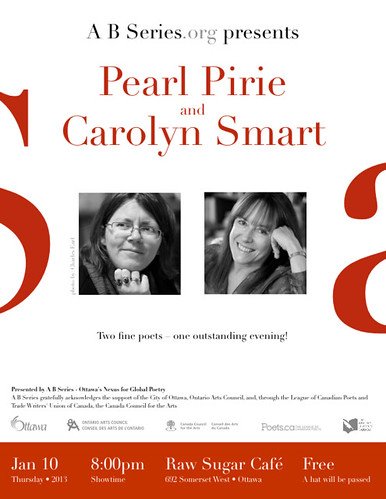
Smart & Pirie in A B Series at Raw Sugar January 10 2012

abseries.org

A B Series Presents

Pearl Pirie & Carolyn Smart

Reading
8pm
Thursday, January 10, 2012

Raw Sugar Café
692 Somerset West
Ottawa, Ont.


Pearl Pirie has poems in a number of chapbooks and in 2 poetry collections, Thirsts (Snare) and been shed bore(Chaudiere). She has 2 more looking for a good home where they will be fed and watered and taken for walks. She makes mini chapbooks with her micro press Phafours. She been organizing the Tree Seed Workshop Series for the Tree Reading Series since 2009. She tweets, photographs and verbs about Ottawa, the luckiest town for literature in most anywhere.

Carolyn Smart's fifth collection of poems, Hooked - Seven Poems was published in 2009 by Brick Books. An excerpt from her memoir At the End of the Day won first prize in the 1993 CBC Literary Contest. She is the founder of the RBC Bronwen Wallace Award for Emerging writers, and since 1989 has taught Creative Writing at Queen's University. Her work-in-progress is a series of poems about the Barrow Gang entitled 'Careen.'


Tuesday, November 27, 2012

bill bissett, Glenn Nuotio & friends - an A B Xmas Party!

abseries.org

A B Series presents its 2nd Annual Xmas Party with bill bissett! 

Featuring a musical set by Glenn Nuotio and friends!

With prizes to be won!

8pm
Saturday, December 8, 2012

Raw Sugar Café
692 Somerset West
Ottawa, Ont. 

bill bissett's charged readings, which never fail to amaze his audiences, incorporate chanting, sound poetry and singing, the verve of which is matched only by his prolific writing career: over 70 books of bissett's poetry have been published. An energetic "man-child mystic," bill bissett is living proof of William Blake's adage "the spirit of sweet delight can never be defiled." 

Combining chamber music and folk, Glenn Nuotio delivers unnervingly complex pop. As Ottawa Xtra! notes, "he channels it through an indie musician's paper heart and the results are invariably stirring." 

Saturday, November 17, 2012

KATALIN LADIK & GERRY SHIKATANI

ABSERIES.ORG

On November 21 at Arts Court Theatre, join us for a multimedia extravaganza featuring the Canadian premiere of Budapest artist, KATALIN LADIK! Presented by A B Series, Ladik comes direct from Hungary for this exclusive engagement. Her performance will incorporate voice, multimedia and on-stage action.


GERRY SHIKATANI, Canadian innovator of multimedia poetry, joins Ladik on the program. Shikatani screens excerpts from his film, 'Kokoro is for Heart' as part of the event.


7:30pm
Weds, November 21, 2012

Arts Court Theatre
2 Daly Avenue
Ottawa, Ont.


Tickets available through the Arts Court box office in person at 2 Daly Avenue, by phone at 613 564 7240 and online at artscourtottawa.ca/en/events/


A polymath artist accomplished in theatrical, literary and visual disciplines, Katalin Ladik’s appearances incorporate voice, multimedia and on-stage action. Author of more than twenty poetry collections, Ladik’s work has been translated into a dozen languages. She is the winner of numerous awards including the bestowal this year of the Laurel Wreath of Hungary. Since her ground-breaking performance at the 10th International Festival of Sound Poetry in Amsterdam in 1977, she has been at the forefront of Europe’s vibrant sound-poetry scene. 

Gerry Shikatani’s most recent poetry collection, The Port's Seasonal Rental, was published last year by Mercury Press/Teksteditions. Shikatani’s diverse writing projects include poetry, prose, text-sound performance, concrete poetry as well as collaboration in experimental film. His journalism has involved sports, travel and international culinary criticism.

**

A B Series - Ottawa's Nexus for Global Poetry

Thursday, November 01, 2012

BQJ Fall Launch & Editors' Reading

Sunday, November 4, 2012, 2-3pm
Collected Works, 1242 WellingtonW.
with music by Jesse Rose,
poetry from contributors
Sylvia Adams, Andre Narbonne,
Myrna Rootham & Matthew Walsh
& local editors Amanda Earl,
Claudia Coutu Radmore & Carol A Stephen.