Showing posts with label Hugh Thomas. Show all posts

Thursday, September 17, 2020

the ottawa small press book fair : home edition #20 : shreeking violet press,

Shortlisted for the 2016 bpNichol Award and winner of the 2013 Diana Brebner Prize, Marilyn Irwin’s work has been published by above/ground press, Apt. 9 Press, Arc Poetry Magazine, bywords.ca, and Puddles of Sky, among others. the day the moon went away is her ninth chapbook. She runs shreeking violet press in Ottawa.

shreeking violet press specializes in hand-made papery things by a variety of emerging and established writers with special consideration given to authors who have historically been at a disadvantage in publishing.

Q: Tell me about your press. How long have you been publishing, and what got you started?

A: shreeking violet press specializes in hand-made papery things by a variety of emerging and established writers with special consideration given to authors who have historically been at a disadvantage in publishing. It began out of desire to make something for a reading I was performing at as part of being named a “Hot Ottawa Voice” by Tree Reading Series in Ottawa in 2014. I used a typewriter and handmade paper and needle and thread and conjured up four little items which I sold that night. Within the next year, I decided I would rather showcase other writers’ voices; soliciting those I admired and wanted to amplify. The first “thing” I made was my first and self-published chapbook “for when you pick daisies” in 2010, but it wasn’t under any press name.

Q: How many times have you exhibited at the ottawa small press fair? How do you find the experience?

A: My first ottawa small press fair as exhibitor was Spring 2015 and I haven’t missed one so I’ve tabled eleven times for shreeking violet press. Small press people are magical because they’re often making things for little to no profit and, more often than not, with blood, sweat and tears poured into their products. It’s a very encouraging and curious community. It’s dangerous to be surrounded by such coveted, usually limited edition items. You want to snatch everything up that catches your eye and be supportive of everyone’s hard work but you also want to break even. Making trades is a win-win which I often do when presented the option. One of my favourite parts is sitting down for drinks at a pub at the end of the day to swap stories of how everyone’s day went where I get to chat with either new friends or friends who live out of the city and who I only get to see as often as the fair occurs. I highly recommend tabling for people just starting out as it’s a great way to meet the community.

Q: Would you have made something specific for this spring’s fair? Are you still doing that? How does the lack of spring fair this year effect how or what you might be producing?

A: I was/am going to be publishing one or two books. The “when” is still uncertain. I’m awaiting final revisions from a mystery author of one of the books and the other book is mine which I still need to edit. I haven’t self-published a book of my own through my own press yet so I thought it might be time. The pandemic has bought us time to sit with our work and neither of us are in a rush to get it out the door by the end of the year so things may defer to next year. It’s a crapshoot at this point, really.

Q: How are you, as a small publisher, approaching the myriad shut-downs? Is everything on hold, or are you pushing against the silences, whether in similar or alternate ways than you might have prior to the pandemic? How are you getting your publications out into the world?

A: When the books are printed, they’ll be available through our Etsy store vs Etsy as well as at the fair. Aside from that, not much else has changed.

Q: Have you done anything in terms of online or virtual launches since the pandemic began? Have you attended or participated in others? How are you attempting to connect to the larger literary community?

A: I have not. I can’t get past how Zooming feels like I’m at work and I’m not one for the spotlight so I’m not interested in hosting or being a visible participant so my camera would be off and I would feel bad for not fully participating so I just haven’t bothered altogether. That’s not to say, I won’t. I think as the colder weeks pass, I’ll be more stir crazy inside and I already miss seeing familiar faces, so, it’s probably inevitable I’ll attend one or even some, at some point.

Q: Has the pandemic forced you to rethink anything in terms of production? Are there supplies or printers you haven’t access to during these times that have forced a shift in what and how you produce?

A: I’ve been avoiding stores due to someone in my bubble being immunocompromised and I usually do my shopping for book material in the real world so I’ll either break down and go to stores or find new suppliers online. This has been a contributing factor to not producing anything as yet this year. My printer works out of her house and we’ve always done porch pick-ups/drop offs so that wouldn’t be an issue.

Q: What are your most recent publications? How might people still be able to order copies?

Caterwaul: Nine Poems by Michael Dennis (2019), Eleven Elleve Alive by Stuart Ross, Dag T. Straumsvåg & Hugh Thomas (2018), and Wintered by Amanda Earl (2017) are the latest books hot off the press. These, and all other books and broadsides published by shreeking violet press can be purchased via our Etsy store: https://www.etsy.com/ca/shop/shreekingvioletpress.

Q: What are you working on now?

A: See above.

Tuesday, March 04, 2014

Recent Reads: Hugh Thomas and N.W. Lea

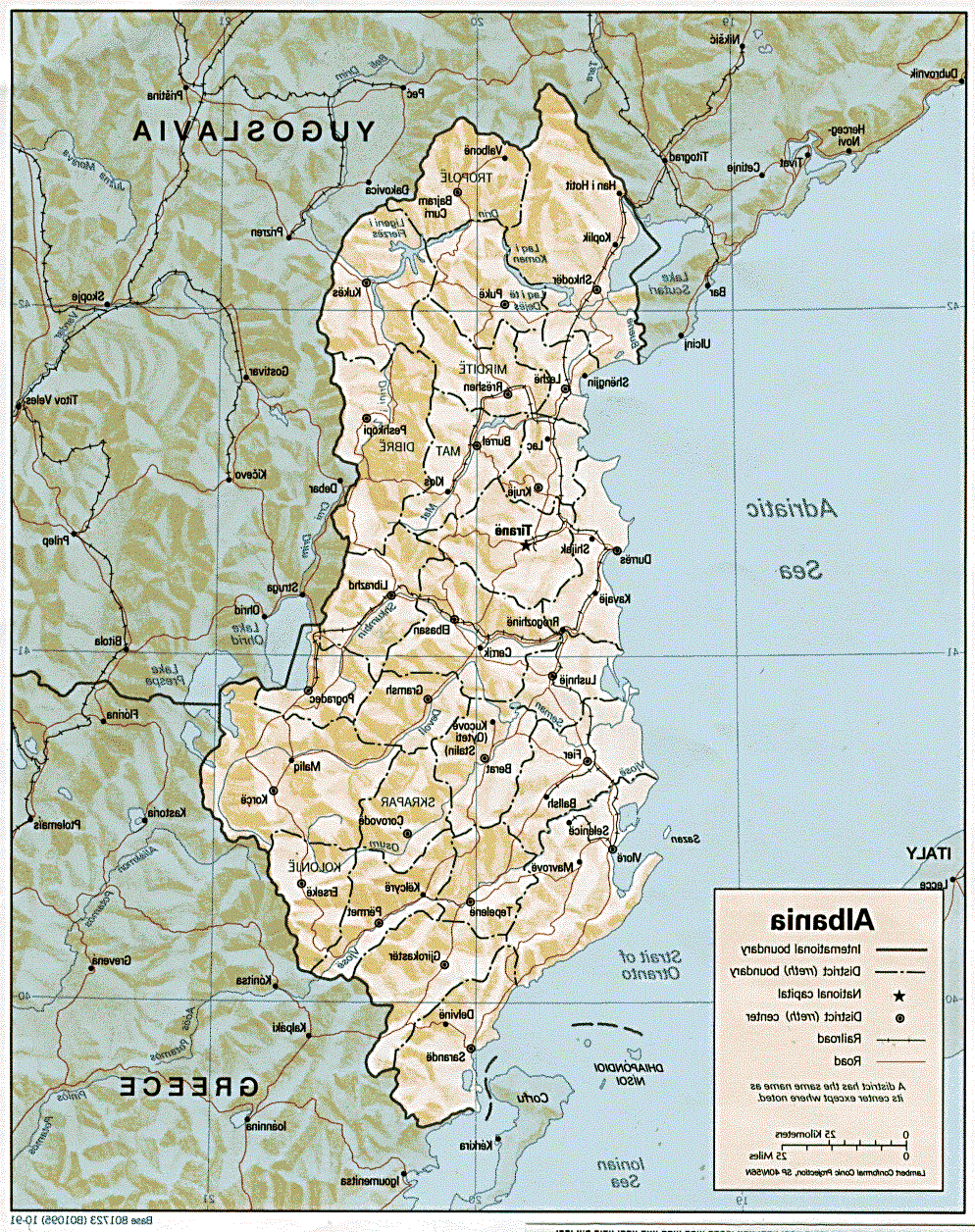
Albanian Suite by Hugh Thomas
Present! by N.W. Lea

Published by above/ground press, 2014.

Translators typically have an agenda when they choose their work. Whether the translation aims to remedy an incomplete version or present literature to a new population, the perceived gesture often determines the public’s approach. But Hugh Thomas’ treatment of poems by Visar Zhiti and a few others not only operates without that explicit gesture, it confesses to not knowing Albanian! Exploring the grey area of translation, Albanian Suite is as much a study in intuition as it is a doorway to improvisation.

Thomas’ key to informal translation involves responding to words as they appear on the page. (My efforts to do the same, focusing on poems Zhiti has had reproduced online, were unproductive.)  However the means of his methodology, it’s clear that Thomas’ poetic guide was at least accompanied by an experienced, geographical one. Signposts of a summer’s escape in Europe colour the culture-rich but cash-poor “Music I heard with you” and the title suite. But broadly speaking, Albanian Suite exists in an overcrowded nexus between languages – so again, Europe – and finds a couple decoding their way through the Mediterranean.

Metropolitan

The two sicknesses frequent in this epoch are heat and isolation.
There are boxes of hotels. We are a collection.
Closet doors, gelatine reductions. Reapparition and sale of automobiles.
Miracles are also part of the equipment.
Painting, recovering, becoming impermeable.
The water is in your family.
Him vs. it: although they dream equally, they do not speak the same
language.
To become free as a fish, enter the universal museum.
Dolphin madrigal, closed water. The subway is culture.
Eat your ticket. Your future is our compromise.
Language is a door. At the door we watch you turning out the lights.

Thomas’ lines are direct and unaccommodating, as if under foreign constraints, yet the linguistics at play resound beyond a surface level of political boundaries. The musicality of the “dolphin madrigal”, like the tokens and tradition that exude a hectic wedding day rhythm in “Epithalamion”, flex the non-verbal ways we navigate space (or lack thereof). Thomas offsets the narrowing effects of language’s deductions as an explorer in “The Strange Mine of Pork Poetry”:

I don’t worry about the garden path, which is different for every letter,
because every letter carries a different experience to the poem. The poem
turns somersaults along the path despite the tower of texts piled atop one
another to deter diversions.

This excerpt, the third of five prose-poem stanzas, also sheds light on Thomas’ attitude toward loose translations, waking up dormant avenues inside each letter. Although unable to find an online bio that lists the languages the author is fluent in, I reckon Thomas does know some Italian (which, as part of my in-house research, has been suggested as a useful tool for cracking Albanian) and perhaps some Swedish. These skills would explain the relative spaciousness of “Clear” (from Italian poet Giuseppe Ungaretti) and “Stars” (by Finnish poet Edith Sodergran), one-off translations that glimmer on the outskirts of Thomas’ jam-packed verse. It’s unclear whether Thomas took more or less creative license with these poems but, alongside one of his loose translations, the morning song “Early”, they’re the poems I find most liberating.

There’s a good deal of improvisation throughout Albanian Suite, as Zhiti’s influence maneuvers traditional stanzas, free verse, a ten-part sequential and a mock review, among others. The latter, entitled “Review”, reads like cut-up words of a poetry review reassembled in scattered order. It may very well be that simple, another angle of translation that excites with the glimpse of something new. From my experience, the degree to which these poems leave their mark is also varied, which is to say the impact of Thomas’ intuition will largely depend on the dexterity of the reader’s. Confusion is a latent component to excitement and certainly part of this translator’s curious agenda.


N.W. Lea’s new chapbook Present! forgoes the responsive processes that layer Albanian Suite, instead centering on small admissions of awareness. Assembled as twenty individually numbered trinkets, these new poems rouse us awake in the midst of minutia: a plain observation, the unspoken portion of a conversation, some inexplicable act or faraway memory. The who, where and why’s couldn’t make it. In fact, those omissions form the connective tissue for each tangent – omissions that put the onus on Lea’s delicate craftsmanship.

Several of these offerings expire within ten words, so it’s telling that Present! digs so much aplomb out of its sparseness. Take the otherwise untitled “9.”:

the doughy flute music
the classical hand
the budding edifices
the braggart

This bite-sized portrayal helps to populate Present!’s rather domesticated neighbourhood but also shows Lea’s mastery of honing in on the small scale. 

“5.

this forest is reckless
with odour

I am on the inside
of an outrageous calm

tiny respite
from the terror

of the temporary

At once skeletal and fully formed, “5.” is an opportunity to revel in ambiguity. The forest, odour, calm and terror each have their proximity to “an outrageous calm” but even that imagery remains elusive. Lea’s disciplined sieve permits only mood and tone to have a fixed presence and it lingers like the afterglow of a good Haiku.

Present! collects unassuming but cleverly managed observations refined over time and, as such, rewards a casual read. Digested over a longer period, however, these poems and their gaps, like communal patches of lawn between houses that neither neighbour can fully enjoy, hang together like a tapestry, all the more memorable for the ways it feels unfinished.