Wednesday, January 30, 2013
Recent Reads: Allison Grayhurst and Shannon Maguire
The River Is Blind by Allison
Grayhurst
A Web Of Holes by Shannon Maguire
Both titles published by
above/ground press, December 2012.
“He
came. He is what everyone needs
But
the pavement is thick
the
ground beneath is rich
saturated
with worms,
moving
thick
with
worm motion
moving
at
worm speed.”
This stanza,
snipped from the tail-end of “In the Thighs”, illustrates an existential
curiosity that courses through Allison Grayhurst’s latest collection. We’ll get
to the “He” part in a minute. But first, it’s Grayhurst’s physical constraints
that comfort us: a box sitting at the top of the stairs, housecats in states of
wakefulness and sleep, the “snails and moss” that preoccupy her. Indeed, The
River Is Blind situates itself firmly in the familial but imbues those
relationships and domestic touchstones with a disembodied calm. Ambition and
disenchantment linger along the fences of Grayhurst’s property but she remains candidly
in the present: embracing “the
comfort of sweaters and knitted socks” for “First Snow of Winter”, “the child
sitting and staring and waiting for the coin” in “Wallpaper Stars”.
In lesser
hands, muses such as these might’ve resulted in verses of weak-kneed
contentedness. But Grayhurst’s voice remains one of detachment, webbing daily
pleasures into greater meditations on love and God – the “He” that churns The
River Is Blind’s family soil. Through spiritual lens, poems like “Everything
Happens” and “Flies” counteract steadfast faith with insights on the material
world, a separate world; a place where people grind flowers for honey. From
“Flies”:
“What
faith was plucked with the flowers
as
all their little tongues reached out to pocket
the
short-term scent?”
Naturally it’s a tad intimidating
when the first word of a first poem has you running for the nearest
dictionary. But “epoché”,
meaning to suspend our understanding of the external world in order to relate to
phenomena on a purely conscious level, proves more an ideological gateway for
Shannon Maguire than a term reserved for Greek philosophy. In A Web Of Holes,
epoché operates
as a palette-cleanser, an italicized provocation plopped down as if to ready us
for enlightenment, however fleeting.
The delight
of Maguire’s long verse doesn’t lie at the heart of some mystic truth but in
the trail of crumbs by which we readers become seekers. Ringing true to my
newfound understanding of epoché, her language prefers a disorienting narrative, one that repeatedly
suspends our ability to find grounded context amid visceral and scholarly hurdles.
“external
acoustic crunch
undulating
forms wet with
reflex
yard
line dirt around her waist
dodecahedron
kiss
in
with clock and guests
climbing
desire
elongated,
erect seconds”
Besides
illustrating her palette for abstract sensuality and Greek imagery, this
excerpt identifies A Web Of Holes as acrostic; E, U, R, Y, D, I, C, and E
trafficking the bulk of Maguire’s verses in honour of Eurydice, wife of
Orpheus. This opens up some juicy parallels between ancient lore and Maguire’s
sharp insights on the ownership of femininity. A temperamental breakdown in
syntax midway through introduces a conflict in reinterpreting Eurydice’s tale;
a commentary on the myth-making roots of Greek literature, perhaps.
You may wish
to keep that dictionary handy but A Web Of Holes wouldn’t be nearly as exciting
without its obfuscations which, with a bit of a learning curve, unveil ephemeral
gems of raw, almost carnal, beauty. To close, here’s an example of Maguire’s
hard-fought harmony:
“Evening’s
gaze, the limit of voice
Unison
of suspension
Ritenuto.
You
watch them
Dying
It
is a bright and chilly morning
Collapse,
there are still not
Enough
independent girls
Eglinton
at five am, floating
Ukiyoe
Rebuilt
from a country road
You
watch them dreaming
Date
the world from those Cordova Street cherry blossoms
Ink
brushes against her forehead
Cassanation
of gossiping motors
Eviction
notice floating, floating”
Labels: above/ground press, Allison Grayhurst, Ryan Pratt, Shannon Maguire
Wednesday, January 23, 2013
Bywords Cornerstone Fundraiser, January 27, 2013
Friday, January 11, 2013
Mark Frutkin: Review of Four Chapbooks from above/ground press
Review of Four Chapbooks from above/ground press
by Mark Frutkin
Selected Canticles by George Elliott Clarke
The Crawdad Cantos (Excerpts from Impossible Books) by Stephen Brockwell
Shikibu Shuffle by Andrew Burke and Phil Hall
Further to Our Conversation – Poems by Robert Kroetsch
A chapbook is by necessity a diminutive taste of poetry. A morsel of a poet’s work – a good introduction to someone you have not previously read or perhaps a reacqaintance, a revisiting with old friends.
I would consider George Elliott Clarke in the ‘old friend’ category, not literally but in the sense that I’ve read much of his poetry over the years (almost all of it, I think) and reviewed previous collections here and there (See http://markfrutkin.blogspot.ca/2011/08/book-review-17-blue-by-george-elliott.html). I would rank his book, Whylah Falls, in my list of top five Canadian collections of poetry, all-time. No other Canadian poet is so lavish with sensual detail and so bold about the physical world and the human body. And in Selected Canticles he delivers again, as he always does, giving us a marvelous slumgullion of a miniature feast, like a serving of appetizers so rich you don’t need to eat the impending meal.
Of course, Clarke always goes for the ear as well as the eye: “not even the squeal of a squall / as waves whacked rock,” or “blossoms blaze a branch.” And he can be humorous too. In ‘À Cristophe Colombe,’ he calls the Spain of Columbus’ day, “a comic-opera Empire”. One can almost picture a Gilbert and Sullivan musical based on Queen Isabella and her famous explorer.
Of course, no one in Canada comes anywhere near Clarke’s ability to write frankly about sex – raw, graphic and straight-up as home-distilled whiskey. He doesn’t scruple to use the good old Anglo-Saxon sex words: fuck, cunt and anus appear liberally throughout these poems, several of which address the black man’s role as hard-driving lover of white women. In a sense, this becomes a trope of the payback for or escape from slavery. Clarke is always conscious of the black man’s position in our world and in history but these poems are not the least bit didactic. They’re the real thing.
No one joins poetry and science as fluidly as Stephen Brockwell. The Crawdad Cantos contains what has become one of my favourite Canadian poems. ‘A Primer for Drainage’ is from The Evangelical Handbook for Engineers, a wonderful conceit to pull together the world of the spirit and the material world of the engineer, builder, scientist. You could be an atheist and still delight in his take on God as inherent in platinum-iridium bars and krypton-86 emissions. The last few lines are so striking, I must quote them in full: “Among time and distances, he is the absolute constant, / the being that lets being be – and every culvert, / aqueduct, conduit, sluice, grate, trench and duct / merely drains the ephemeral projection of his eternal tears.” I think including the word ‘duct’ in that list is a sure sign of poetic brilliance as it resonates with the last word of the poem, ‘tears’.
There are other excellent poems here, especially ‘Parrots not in Cleveland’ (from Cantos of the 1%). Besides the fact that Cleveland, my birthplace, hardly ever appears in a Canadian poem, this poem has a humorous tone that I very much appreciate. Drinking banana daiquiris in Cleveland in March is odd enough as the subject for a poem but the poet also says he can imitate a parrot’s voice: “I’ll need a trumpet, / a trunk full of Hawaiian shirts, a pair / of holey sneakers spattered with blue paint, / a month of sunlight to give this snow the shaft”. ‘Sunlight’ and ‘shaft’ – once again, a brilliant juxtaposition that plays on the two definitions for ‘shaft’. And again, this poem ends with a striking image. But I urge you to pick up this chapbook to learn what it is.
In Shikibu Shuffle, two poets, Andrew Burke from Australia and Phil Hall from Perth, (who won the Governor General’s Award for Poetry for his fascinating book, Killdeer) have collaborated to produce a collection of fifteen poems based on the five-line form used by the Japanese poet, Murasaki Shikibu (973-1014). Each poem here is ten lines long (with a few variations). It’s difficult, if not impossible, to determine who wrote what, and exactly how the process worked. In any case, the result is a kind of medieval Japanese jazz with a flowing series of riffs that sometimes connect and sometimes don’t. The musical play here reminds me somewhat of Jack Kerouac’s Mexico City Blues (which was influenced more by hardcore jazz than what we now consider the blues). There’s a vibrancy and freedom to the images and their links here, in this back and forth ‘shuffle’, and sometimes the results are striking: “a Chinese dragon of smoke / wearing my dead friend’s clothes / above the marina” or “pale cuticle” (for the moon), or the exceedingly strange and suggestive “to weave submerged antlers / breathing blue at their tips”. This is a collection that can be read more than twice.
The very fine poet (and novelist), Robert Kroetsch, died in 2011. This small chapbook, Further to Our Conversation, consists of three letter-poems to friends, interspersed with three very short poems. The first letter-poem, ‘Dear John Lent’, reveals the wonderful line, “Our first cry is a poem that contains everything” and the intriguing phrase “Icarus in a car...” These actually do feel like thoughts that came to Kroetsch after a late-night conversation with a friend, a kind of soliloquy inspired by a dialogue. Kroetsch’s poetry was always wonderfully experimental and refused to hew to the straight and narrow furrows that characterize much of mainstream Canadian verse. I see him running his plough in all sorts of mad geometries across those prairie fields: ovals within ovals, spirals, secret divinatory crop circles of poetry. His sense of the comic is excellent: “Punctuation is a middle-class pretension. So is a toothache. In heaven you have to sit eternally staring at a bright light, so be sure to take your dark glasses.” (‘Dear Jeff Carpenter’) He ends the same poem with the wonderful lines: “I once travelled halfway across Spain to see St Teresa’s bent left elbow safe in a glass jar. We each write poems as we see fit. But then, what poem isn’t a relic?” (It makes me want to ask if St Teresa wrote left-handed!)
Another line in ‘Dear Jeff Carpenter’ makes light of the inevitable, and probably tells us much about what kind of person and poet Robert Kroetsch was. In four words that embody a kind of simplicity, acceptance and peace, he writes: “Death, that necessary pest.”
by Mark Frutkin
Selected Canticles by George Elliott Clarke
The Crawdad Cantos (Excerpts from Impossible Books) by Stephen Brockwell
Shikibu Shuffle by Andrew Burke and Phil Hall
Further to Our Conversation – Poems by Robert Kroetsch
A chapbook is by necessity a diminutive taste of poetry. A morsel of a poet’s work – a good introduction to someone you have not previously read or perhaps a reacqaintance, a revisiting with old friends.
I would consider George Elliott Clarke in the ‘old friend’ category, not literally but in the sense that I’ve read much of his poetry over the years (almost all of it, I think) and reviewed previous collections here and there (See http://markfrutkin.blogspot.ca/2011/08/book-review-17-blue-by-george-elliott.html). I would rank his book, Whylah Falls, in my list of top five Canadian collections of poetry, all-time. No other Canadian poet is so lavish with sensual detail and so bold about the physical world and the human body. And in Selected Canticles he delivers again, as he always does, giving us a marvelous slumgullion of a miniature feast, like a serving of appetizers so rich you don’t need to eat the impending meal.
Of course, Clarke always goes for the ear as well as the eye: “not even the squeal of a squall / as waves whacked rock,” or “blossoms blaze a branch.” And he can be humorous too. In ‘À Cristophe Colombe,’ he calls the Spain of Columbus’ day, “a comic-opera Empire”. One can almost picture a Gilbert and Sullivan musical based on Queen Isabella and her famous explorer.
Of course, no one in Canada comes anywhere near Clarke’s ability to write frankly about sex – raw, graphic and straight-up as home-distilled whiskey. He doesn’t scruple to use the good old Anglo-Saxon sex words: fuck, cunt and anus appear liberally throughout these poems, several of which address the black man’s role as hard-driving lover of white women. In a sense, this becomes a trope of the payback for or escape from slavery. Clarke is always conscious of the black man’s position in our world and in history but these poems are not the least bit didactic. They’re the real thing.
No one joins poetry and science as fluidly as Stephen Brockwell. The Crawdad Cantos contains what has become one of my favourite Canadian poems. ‘A Primer for Drainage’ is from The Evangelical Handbook for Engineers, a wonderful conceit to pull together the world of the spirit and the material world of the engineer, builder, scientist. You could be an atheist and still delight in his take on God as inherent in platinum-iridium bars and krypton-86 emissions. The last few lines are so striking, I must quote them in full: “Among time and distances, he is the absolute constant, / the being that lets being be – and every culvert, / aqueduct, conduit, sluice, grate, trench and duct / merely drains the ephemeral projection of his eternal tears.” I think including the word ‘duct’ in that list is a sure sign of poetic brilliance as it resonates with the last word of the poem, ‘tears’.
There are other excellent poems here, especially ‘Parrots not in Cleveland’ (from Cantos of the 1%). Besides the fact that Cleveland, my birthplace, hardly ever appears in a Canadian poem, this poem has a humorous tone that I very much appreciate. Drinking banana daiquiris in Cleveland in March is odd enough as the subject for a poem but the poet also says he can imitate a parrot’s voice: “I’ll need a trumpet, / a trunk full of Hawaiian shirts, a pair / of holey sneakers spattered with blue paint, / a month of sunlight to give this snow the shaft”. ‘Sunlight’ and ‘shaft’ – once again, a brilliant juxtaposition that plays on the two definitions for ‘shaft’. And again, this poem ends with a striking image. But I urge you to pick up this chapbook to learn what it is.
In Shikibu Shuffle, two poets, Andrew Burke from Australia and Phil Hall from Perth, (who won the Governor General’s Award for Poetry for his fascinating book, Killdeer) have collaborated to produce a collection of fifteen poems based on the five-line form used by the Japanese poet, Murasaki Shikibu (973-1014). Each poem here is ten lines long (with a few variations). It’s difficult, if not impossible, to determine who wrote what, and exactly how the process worked. In any case, the result is a kind of medieval Japanese jazz with a flowing series of riffs that sometimes connect and sometimes don’t. The musical play here reminds me somewhat of Jack Kerouac’s Mexico City Blues (which was influenced more by hardcore jazz than what we now consider the blues). There’s a vibrancy and freedom to the images and their links here, in this back and forth ‘shuffle’, and sometimes the results are striking: “a Chinese dragon of smoke / wearing my dead friend’s clothes / above the marina” or “pale cuticle” (for the moon), or the exceedingly strange and suggestive “to weave submerged antlers / breathing blue at their tips”. This is a collection that can be read more than twice.
The very fine poet (and novelist), Robert Kroetsch, died in 2011. This small chapbook, Further to Our Conversation, consists of three letter-poems to friends, interspersed with three very short poems. The first letter-poem, ‘Dear John Lent’, reveals the wonderful line, “Our first cry is a poem that contains everything” and the intriguing phrase “Icarus in a car...” These actually do feel like thoughts that came to Kroetsch after a late-night conversation with a friend, a kind of soliloquy inspired by a dialogue. Kroetsch’s poetry was always wonderfully experimental and refused to hew to the straight and narrow furrows that characterize much of mainstream Canadian verse. I see him running his plough in all sorts of mad geometries across those prairie fields: ovals within ovals, spirals, secret divinatory crop circles of poetry. His sense of the comic is excellent: “Punctuation is a middle-class pretension. So is a toothache. In heaven you have to sit eternally staring at a bright light, so be sure to take your dark glasses.” (‘Dear Jeff Carpenter’) He ends the same poem with the wonderful lines: “I once travelled halfway across Spain to see St Teresa’s bent left elbow safe in a glass jar. We each write poems as we see fit. But then, what poem isn’t a relic?” (It makes me want to ask if St Teresa wrote left-handed!)
Another line in ‘Dear Jeff Carpenter’ makes light of the inevitable, and probably tells us much about what kind of person and poet Robert Kroetsch was. In four words that embody a kind of simplicity, acceptance and peace, he writes: “Death, that necessary pest.”
Labels: above/ground press, Andrew Burke, George Elliott Clarke, Mark Frutkin, Phil Hall, review, Robert Kroetsch, Stephen Brockwell
Wednesday, January 09, 2013
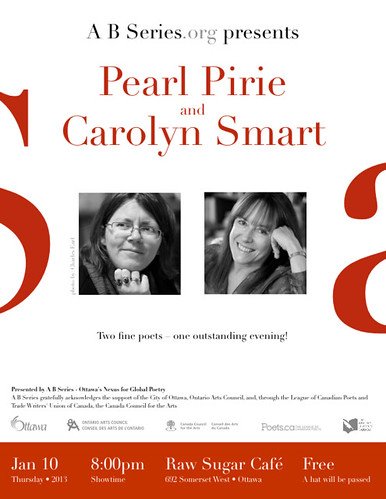
Smart & Pirie in A B Series at Raw Sugar January 10 2012
![]() |
| abseries.org A B Series Presents Pearl Pirie & Carolyn Smart Reading 8pm Thursday, January 10, 2012 Raw Sugar Café 692 Somerset West Ottawa, Ont. Pearl Pirie has poems in a number of chapbooks and in 2 poetry collections, Thirsts (Snare) and been shed bore(Chaudiere). She has 2 more looking for a good home where they will be fed and watered and taken for walks. She makes mini chapbooks with her micro press Phafours. She been organizing the Tree Seed Workshop Series for the Tree Reading Series since 2009. She tweets, photographs and verbs about Ottawa, the luckiest town for literature in most anywhere. Carolyn Smart's fifth collection of poems, Hooked - Seven Poems was published in 2009 by Brick Books. An excerpt from her memoir At the End of the Day won first prize in the 1993 CBC Literary Contest. She is the founder of the RBC Bronwen Wallace Award for Emerging writers, and since 1989 has taught Creative Writing at Queen's University. Her work-in-progress is a series of poems about the Barrow Gang entitled 'Careen.' |
Labels: A B Series, Carolyn Smart, Ottawa events, Pearl Pirie, Raw Sugar Cafe